






Published Thursday, June 11, 2026 by Elena R. in Popular Dogs
The short answer is yes. But the families that ask this question before they get one, and want the real answer, deserve more than that.
Mini Bernedoodles have earned an excellent reputation as family dogs, and most of that reputation is accurate. They're affectionate, playful, emotionally intuitive, and are known to bond deeply with everyone in the household. They're the kind of dog that follows the kids around the backyard, finds its way into every family photo, and somehow ends up in the middle of the couch by 8pm. That part is real.
What's less often said: the path to that version of your dog takes time, consistency, and a household that genuinely understands what it's getting into. A Mini Bernedoodle thrives as a family dog. A Mini Bernedoodle in a household that underestimated the puppy phase, skipped training, or can't meet its social needs will struggle and make the family struggle too.
This guide covers what makes Mini Bernedoodles well-suited for family life, what the first year looks like, how they fit with different ages and household situations, and what separates the families who describe this breed as perfect from the ones who felt blindsided.
Table of Contents
- What Makes Mini Bernedoodles Family-Oriented by Design
- The Real Strengths for Family Life
- What Year One With a Family Mini Bernedoodle Looks Like
- Age Compatibility: Toddlers, School-Age Kids, and Teens
- The Family-Specific Challenges
- Multi-Pet Households
- Space and Lifestyle Fit
- What Separates Families Who Thrive From Those Who Struggle
- Final Thoughts
What Makes Mini Bernedoodles Family-Oriented by Design
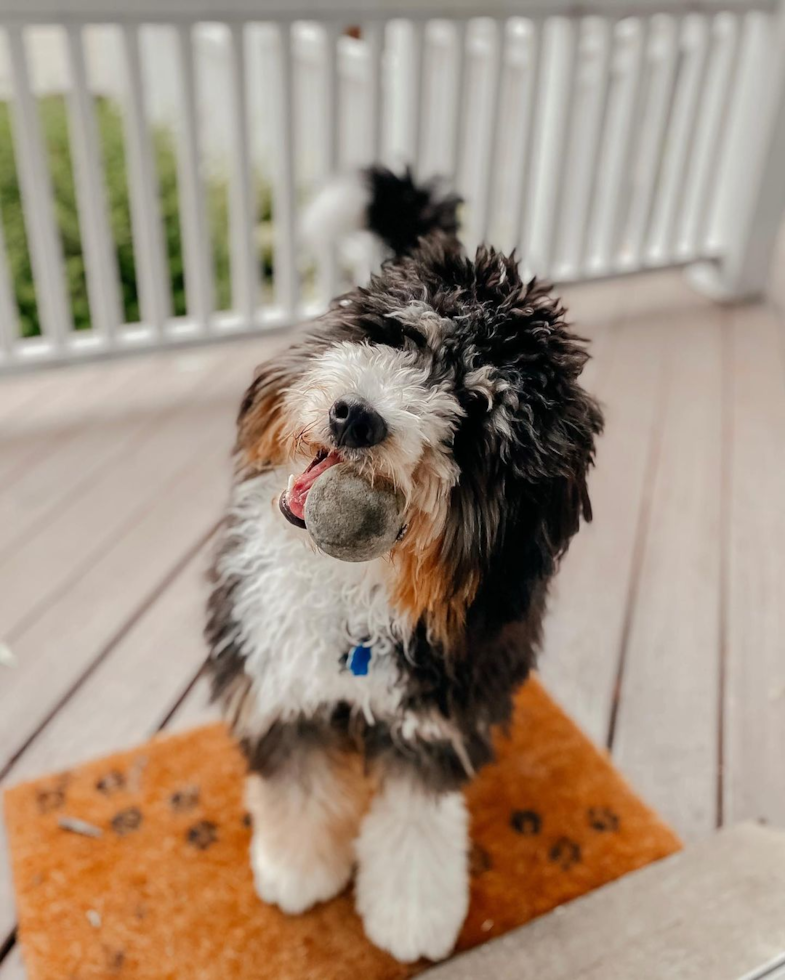
Understanding why Mini Bernedoodles work as family dogs starts with understanding the two breeds they came from and what each one was bred to do.
Bernese Mountain Dogs spent centuries working alongside farm families in the Swiss Alps. Not as guard dogs, not as herding dogs, but as draft and companionship dogs, animals that pulled carts through villages, moved alongside children, and lived embedded in daily household life. The breed's temperament standard explicitly lists aggression as a disqualifying fault. "Devoted" appears in nearly every description of ideal Bernese character, and it's not a marketing word. It's a trait that was selected for across generations because dogs without it weren't bred. That history matters. Families who live with Mini Bernedoodles describe the devotion first. The rest follows.
The Miniature Poodle side adds something different. Poodles are emotionally quick. They read social cues, notice patterns fast, and form strong attachments to the people they spend time with. They're also more active than their image suggests. A Poodle cross in the house is not a decorative companion. It's a participant. That active intelligence is part of what makes Mini Bernedoodles so responsive within family environments, and it's also part of what makes training so effective when it's done consistently.
Most Mini Bernedoodles land somewhere between the two profiles: more settled and loyal than a full Poodle, more curious and engaged than a classic Bernese. The exact mix depends on the individual dog, the generation, and which parent's traits dominate. Two puppies from the same litter can develop into noticeably different adults. The baseline holds across most of them, though. People-attached, family-oriented, emotionally responsive. Results vary. The baseline doesn't.
The Real Strengths for Family Life
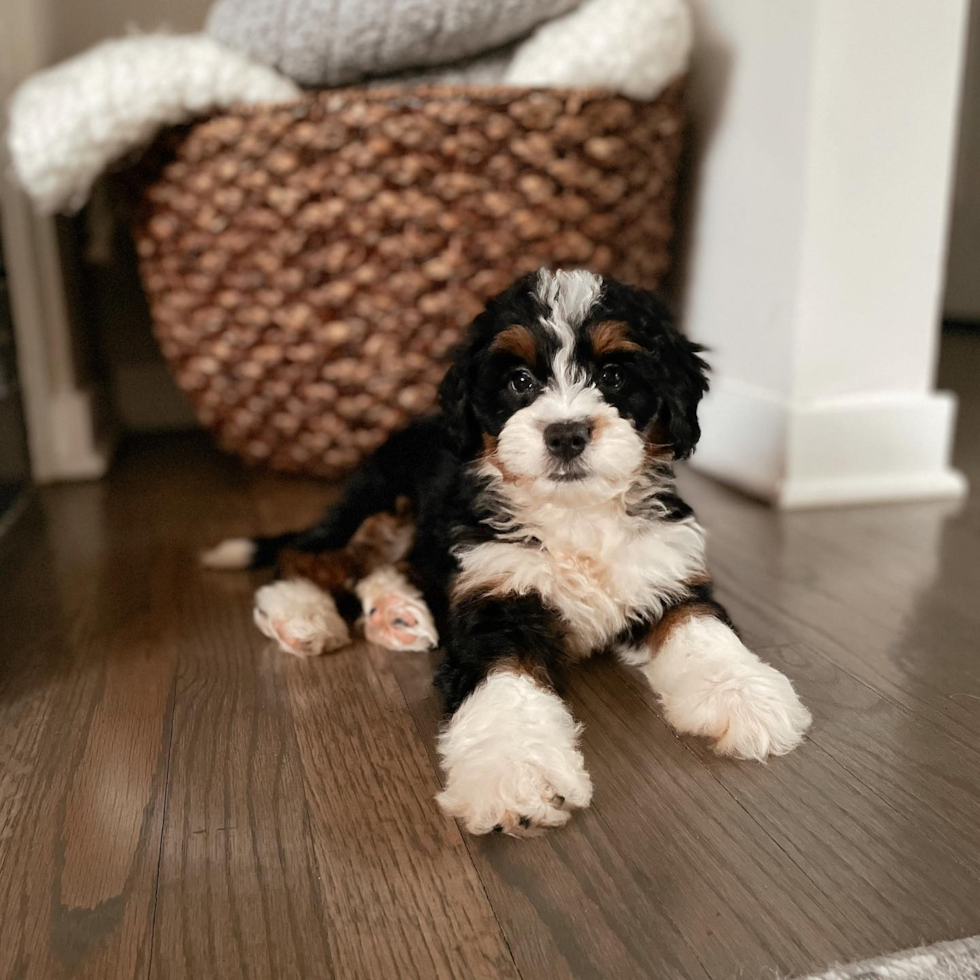
They Read the Room
Mini Bernedoodles seem to know when something is off before anyone announces it. Owners describe it in consistent terms: the dog gravitates toward whoever had a hard day. It settles when the house goes quiet. It ramps up when kids come running through the door. Someone cries, and the dog is already there.
Some of this is intelligence. Some of it is the attentiveness that comes from a breed that has spent generations paying close attention to people. Either way, owners talk about it constantly and it's one of the qualities that makes living with a Mini Bernedoodle feel different from living with a less people-focused dog. The dog doesn't just occupy the house. It participates in it.
Intelligence That Works For Families When Families Work With It
Mini Bernedoodles pick up household routines quickly and can learn the kind of practical manners that make daily life easier: don't knock over the toddler, don't raid the counter, greet guests with four paws on the floor. Training sessions are often something they look forward to, not something they endure. The desire to interact and cooperate is genuinely there.
The tradeoff is that the same brain that learns rules fast also learns which rules are optional. A dog that has figured out Dad corrects jumping but Mom greets it that way every evening has not learned "no jumping." It has learned the rule is conditional. Smart dogs are skilled negotiators. A household where everyone enforces things the same way produces a dramatically better result than one where training is someone's personal project that the rest of the family quietly undoes.
Harsh corrections don't work well here. These dogs are emotionally sensitive, and punishment-based training creates anxiety and avoidance rather than reliability. You earn cooperation by making it worth their while. Usually that's easier than it sounds.
Size That Actually Fits Most Family Situations
A full grown Mini Bernedoodle typically lands between 25 and 45 pounds, though some push closer to 50 depending on genetics and generation. That range sits in a useful middle ground for most families. They are sturdy enough for active kids and hikes and roughhousing in the yard, compact enough to manage in everyday life without it becoming a production.
One thing worth naming: 35 pounds moving at full enthusiasm can still knock a small child over. The size is appropriate for most family situations, but it doesn't make supervision optional around toddlers. It just makes the math a little more forgiving than it would be with a 90-pound dog.
They Belong to the Whole Household
Some breeds pick a person. Mini Bernedoodles like to distribute. Most develop genuine warmth toward every regular member of the household, with deeper closeness to whoever spends the most consistent time with them, but without the indifference toward everyone else that more one-person breeds show.
This matters more than people expect. Families have multiple kids at different ages, schedules shift, the primary caregiver changes, teenagers go off to college. A dog that belonged to the whole household adapts to those changes better than one that fixated on a single person. Owners regularly describe this quality as one of the things they value most after a few years with the breed.
What Year One With a Family Mini Bernedoodle Looks Like

This is probably the part that would have been most useful to families who felt blindsided.
The first six to eight weeks after a Mini Bernedoodle puppy comes home are chaotic in a way that's hard to describe without sounding dramatic. The puppy will bite - mouthy, persistent, sometimes hard enough to break skin. It will wake up at night. It will have accidents indoors after what felt like a successful outdoor trip. It will need 16 to 20 hours of sleep per day, which it will resist taking, and then it will have what trainers call the land shark hour when overtiredness finally wins. Kids find this phase exciting until the biting is directed at them.
This is normal. And it ends faster and more smoothly for households where the whole family is on the same page about crate training, rest schedules, and consistent responses to biting.
Between about six and eighteen months, the adolescent phase arrives and it surprises owners who thought they were past the hard part. The Mini Bernedoodle that was learning beautifully at four months may seem to forget its training entirely at nine months. Recall stops working. Impulse control evaporates. Some dogs develop new fears during a secondary fear period that can appear anytime between six and fourteen months. A dog that confidently accepted strangers may become reactive. A dog that handled kids' chaos without issue may start flinching at fast movement.
This phase is neurological, not a sign the dog turned bad. It passes. But staying consistent through it, especially when it doesn't feel like training is working, is what produces the calm, reliable family dog at age two and three.
By the time a Mini Bernedoodle reaches about two years old, most families describe a dramatically different dog. Settled, affectionate, genuinely easy to live with.
Age Compatibility: Toddlers, School-Age Kids, and Teens

With Toddlers: The Most Complex Situation
Toddlers and Mini Bernedoodles can coexist happily. They can also create a genuinely difficult situation that both the dog and the toddler experience as stressful. It depends heavily on how the household is managed.
Toddlers are unpredictable by nature - fast movements, sudden squeals, unsteady falling, grabbing without warning, and a complete inability to understand or follow dog-interaction rules. Even a patient, well-socialized Mini Bernedoodle has a threshold, and a toddler's behavior can hit it in ways that weren't anticipated. An excited puppy can accidentally knock a toddler over. A toddler who grabs a puppy's ear can trigger a snap from a dog that otherwise has no history of that behavior.
None of this means the combination doesn't work. It means it requires supervision and management rather than assumption. Giving the dog safe spaces away from the toddler, teaching the dog a reliable exit behavior, and supervising interactions rather than assuming they're fine because the dog is "gentle" makes a significant difference. Many families with toddlers and Mini Bernedoodles describe very positive experiences - the dog ends up protective and affectionate with the young child. But those families are usually the ones who stayed present during interactions rather than leaving it to chance.
With School-Age Kids: The Sweet Spot
The combination that consistently produces the best outcomes is Mini Bernedoodles with children roughly between five and twelve years old. This age range is old enough to follow interaction rules, consistent enough to participate in training, and physical enough to keep up with the dog's energy and play preferences.
School-age kids are often the family members the dog bonds most intensely with. They're home in the afternoon. They play fetch and tug and chase. They provide the kind of high-energy, sustained interaction that Mini Bernedoodles genuinely love. The emotional connection that forms between a Mini Bernedoodle and a school-age child is something owners talk about for years.
With Teenagers: Training Partners
Teens make excellent Mini Bernedoodle companions when they're engaged with the dog. The combination of a teenager's capacity for independent work and a Mini Bernedoodle's intelligence and people-focus can produce impressive results in training, trick work, or activity sports. The risk with teenagers is that the dog becomes someone else's responsibility - mom and dad's dog that the teenager grew up with but is no longer particularly involved in. Mini Bernedoodles don't handle being deprioritized particularly well.
The Family-Specific Challenges

Separation Anxiety in Busy Household Schedules
Here's the scenario that catches busy families off guard: the kids go to school at 7:30am. Both parents leave for work by 8:30am. Everyone is home by 4pm. The Mini Bernedoodle, which has bonded deeply with everyone and has spent the first few months of life with constant household activity, is now alone for seven or eight hours a day.
Mini Bernedoodles are predisposed to separation anxiety precisely because they're so family-oriented. A puppy that didn't receive structured independence training - gradual alone-time practice, crate training, learning to settle when people are present but unavailable - often doesn't know what to do with itself when everyone is suddenly gone. The result can be destructive behavior, persistent vocalizing, and a dog that degrades with every hour of isolation.
Independence training should start from the first days in the home, not after the problem appears. Crate training, short practice departures that build gradually, and teaching the puppy to rest in a separate space while family members are home but doing their own things, all of this shapes a dog that can handle the family's real schedule. Skipping this in favor of constant attention during puppy weeks is the most common setup for a serious separation anxiety problem later.
Grooming as a Family Commitment
A Mini Bernedoodle's coat requires brushing every two to three days to prevent matting, more often during heavy activity and outdoor play. Professional grooming every six to eight weeks adds up to roughly $100 to $150 per appointment depending on location and coat condition. In a busy household where the brushing schedule slips, the cost of grooming typically goes up because dematting requires additional time.
This isn't a complaint about the breed. It's a commitment that families sometimes discover is larger than they expected, especially with children who are hard on dogs' coats (dirt, water, tangles from play). Building grooming into the family routine early, ideally starting with positive short grooming sessions when the dog is a puppy so it accepts the process calmly as an adult, makes a real difference.
Training Requires Consistency Across Everyone
A Mini Bernedoodle will learn the rules you enforce, including the exceptions you consistently make. If the dog jumps up and one family member corrects it while another greets it that way every time, the dog doesn't learn not to jump. It learns the rule is optional. Multiply that across every household behavior, and you can end up with a dog that seems selectively trained and behaves well for one person, but ignores the rules with everyone else.
This isn't a failure of the dog's intelligence. It's the predictable result of inconsistent input into a highly intelligent animal that is paying close attention to who enforces what.
The most successful family households designate a primary trainer and then bring every other family member into consistent compliance. Kids who are old enough to participate should be taught the commands and the reinforcement. Guests and relatives should be briefly told what the current rules are. It sounds like more effort than it should be, and it is. The resulting dog makes it worth it.
Energy Management in a Family Context
Mini Bernedoodles need roughly 45 to 60 minutes of physical exercise per day for a healthy adult dog, plus mental stimulation through training, games, and enrichment. For most active families, this is easy. For families with demanding schedules, young children who require significant attention, or limited outdoor access, meeting those needs consistently can become a pressure point.
An under-exercised Mini Bernedoodle expresses that unmet need. Zoomies through the living room. Persistent nudging for attention. Chewing. Barking at nothing in particular. These aren't personality flaws; they're a dog communicating that something it needs isn't being provided. Building exercise into the family routine reliably prevents most of it.
RELATED: Are Mini Bernedoodles Smart?
Multi-Pet Households
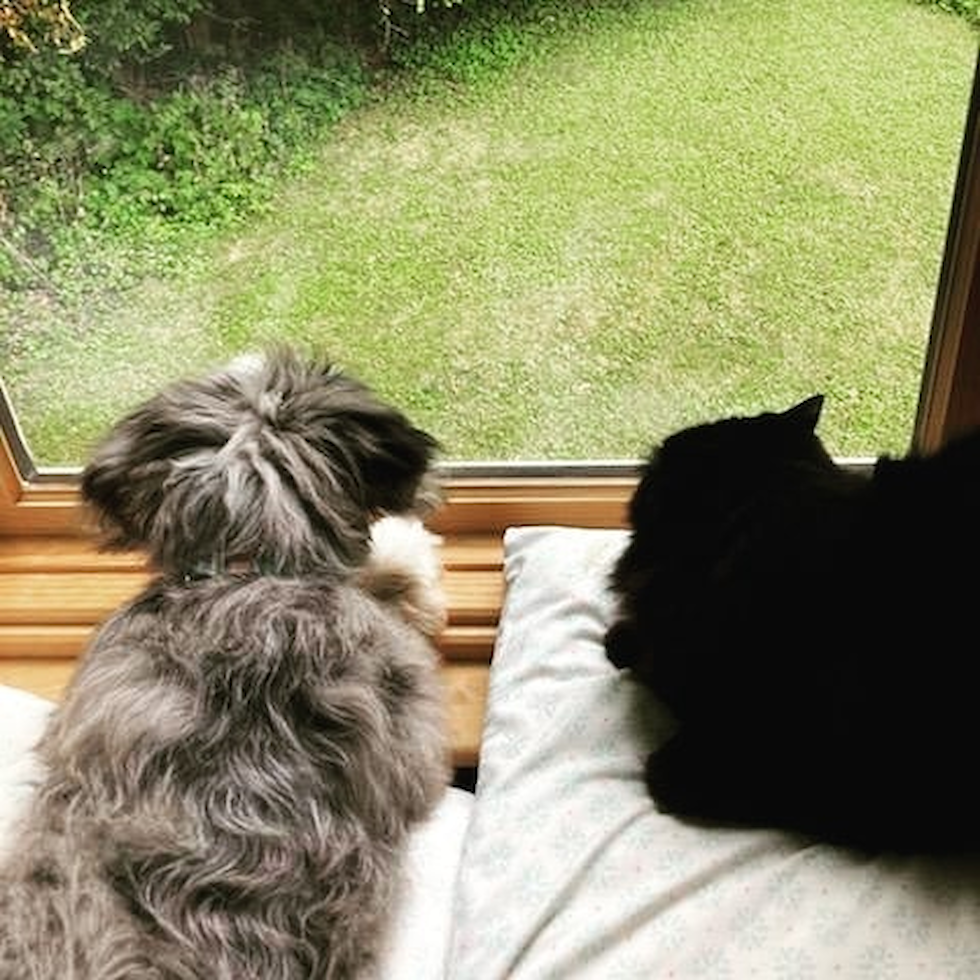
Mini Bernedoodles are not territorial dogs. They approach other animals with curiosity more than aggression, and many families run households with a Mini Bernedoodle alongside other dogs, cats, and occasionally smaller pets without conflict. The Poodle influence contributes to a socially flexible temperament that doesn't fixate on ownership of space or resources the way more guarding-oriented breeds might.
The scenario that catches families off guard most often isn't the dog-to-dog relationship long-term, but the first few months after the puppy comes home. A Mini Bernedoodle puppy has approximately one setting: let's play, right now, at full intensity. The seven-year-old resident dog who has never once asked for this arrangement will make its feelings clear. Some resident dogs set boundaries quickly and the puppy respects them. Others spend several weeks looking like they're reconsidering everything.
The practical management piece: give the resident pet reliable access to space the puppy can't reach. A baby gate, a room with a closed door, a crate the older dog can rest in while the puppy is out and very enthusiastic - these aren't dramatic interventions, just ways to make sure the dog that was there first isn't constantly overwhelmed by the new arrival. Forcing shared space before both animals are comfortable usually creates lasting tension that takes much longer to resolve than the patience it would have taken upfront.
Cats are a mixed picture. Many Mini Bernedoodles adapt well when introductions happen slowly and the cat has reliable escape routes. Some show more interest in chasing than their owners anticipated. Individual variation is real here, and early socialization makes a meaningful difference.
Space and Lifestyle Fit

Mini Bernedoodles care far more about what's happening in the space than how large it is. Apartment families who walk consistently, provide mental stimulation, and include the dog in daily routines raise well-adjusted Mini Bernedoodles. Suburban families with full yards who are rarely home and treat exercise as an afterthought tend to end up with a dog that expresses its boredom loudly and creatively. Square footage doesn't solve the variable.
That said, a yard removes friction in ways that matter on an ordinary Tuesday. Off-leash zoomies don't require putting on shoes. A rainy afternoon doesn't derail the exercise plan entirely. The dog can burn off energy between obligations rather than waiting for a scheduled walk that keeps getting postponed. None of that is essential. It's just the difference between a routine that runs smoothly and one that requires active management to stay on track.
The lifestyle fit matters more than anything else. An active family that hikes on weekends, takes the dog on errands, and includes it in household life will raise a balanced Mini Bernedoodle in a two-bedroom apartment without drama. A family in a four-bedroom house with a big yard that works long hours, skips walks when tired, and expects the dog to mostly entertain itself will have a harder time regardless of how much space is available. Mini Bernedoodles follow their people. That's the point of them. Homes where people are present and engaged produce calmer, better-adjusted dogs than homes with more square footage but less of that.
What Separates Families Who Thrive From Those Who Struggle

A particular type of story comes up fairly often in Mini Bernedoodle owner discussions. The family got the puppy over the holidays, kids were home, everyone was around, the puppy had constant attention and company for three weeks. Then January came. Kids back at school. Both parents back to full workdays. The puppy that had never been alone for more than twenty minutes was suddenly alone for seven hours. By week three, neighbors were mentioning the barking.
This isn't a breed failure, but a setup failure. And it's the most common version of the story.
Families who describe Mini Bernedoodles as the right dog for them share a few recognizable qualities. They read about the puppy phase before the puppy came home, not to be scared, but so the biting and the land shark hour and the first night crying didn't arrive as surprises. They started crate training and alone-time practice in week one, before it felt urgent. They understood the adolescent regression was coming and stayed consistent through it rather than concluding the dog had changed personalities.
They also treated training as a household project. Everyone in the family knew the rules and enforced them the same way. Not perfectly, but consistently enough that the dog couldn't work out a set of exceptions for each person. Kids were involved. Guests were briefly informed.
And they built the maintenance into the routine with walks, brushing, grooming appointments, not because they had unlimited time, but because they understood those weren't optional add-ons. They were the reason the dog stayed pleasant to live with.
Families who struggled usually started with the same dog and the same intentions. The difference was structure. The breed's underlying warmth and family-orientation is genuine. It's also not self-sustaining. It responds to what the household puts in.
Final Thoughts

Mini Bernedoodles became popular as family dogs for genuine reasons. They're emotionally connected, adaptable, great with kids when properly introduced, and built to be part of a household rather than adjacent to one. The qualities that make people fall in love with the breed are real, and they tend to get better as the dog matures.
At the same time, the first year is harder than the reputation suggests. The separation anxiety risk is real for households with demanding schedules. Grooming requires actual commitment. Training requires consistency from everyone in the family, not just the primary owner. And the breed's deep need for connection, the quality that makes them so rewarding to live with, can become genuinely stressful if a family's lifestyle doesn't accommodate it.
Most of the best qualities come attached to the biggest challenges. The affection that makes Mini Bernedoodles so rewarding to live with is the same trait that makes separation anxiety more likely. The intelligence that makes training so satisfying is the same trait that makes inconsistency so costly. The family-orientation that makes them feel like real members of the household is the same orientation that requires the household to actually show up.
For the right family that's engaged, consistent, and realistic about the commitment, this breed delivers on everything it's known for. The answer is yes. But the yes is earned, not assumed.
Elena R.
About The Author
Elena is a leading expert in the field of dog behavior, care, and training, with over a decade of experience in writing about dogs. As a published writer and lifelong dog enthusiast, Elena currently shares her home with three beloved canine companions. She is dedicated to staying up to date on the latest advancements in dog care and training, ensuring that her articles provide readers with accurate and valuable insights. With her extensive knowledge and passion for all things canine, Elena's contributions to the Premier Pups community offer both expertise and authority on a wide range of dog-related topics.
What To Read Next

Mini Bernedoodle Pros and Cons
Mini Bernedoodles have become one of the most talked-about doodle breeds in recent years. It’s easy to understand why. They’re fluffy, expressive, affectionate, and kind of hard to ignore once you spend time around one. A lot of people picture the perfect... Read More

Are Mini Bernedoodles Aggressive? What Owners and Experts Say
Mini Bernedoodles have a reputation that precedes them. Fluffy, affectionate, deeply people-oriented — the kind of dog that greets every visitor like a long-lost friend and considers your lap a permanent reservation.
Mini bernedoodles are not an aggressive... Read More
Frequently Asked Questions
Are Mini Bernedoodles good with kids? Yes, most Mini Bernedoodles are gentle, playful, and patient with children. They tend to be affectionate rather than standoffish and often form especially close bonds with school-age kids. Supervision matters with toddlers, as even a gentle dog can accidentally knock over a small child during excited play. The combination consistently works best when the whole family is involved in training and the dog receives consistent handling from everyone.
Are Mini Bernedoodles good for first-time dog owners with kids? They can be, provided the family goes in with realistic expectations. Mini Bernedoodles are trainable, people-focused, and genuinely want to cooperate—qualities that make them more manageable for new owners than high-energy or independent breeds. The challenges first-time owners encounter most often are the puppy biting phase, the adolescent regression around 6 to 18 months, and managing separation anxiety if independence training is skipped early. Understanding these before the puppy comes home removes most of the surprise.
How do Mini Bernedoodles do with babies and toddlers? Many Mini Bernedoodles are patient and gentle around very young children, but toddlers require a more actively managed situation than older kids. Toddlers move unpredictably, grab without warning, and can't follow interaction rules consistently. Giving the dog a safe space to retreat from the toddler, supervising interactions, and teaching the dog a reliable settle or exit behavior creates a much more positive dynamic than assuming gentleness is enough.
Do Mini Bernedoodles have separation anxiety in family homes? They're predisposed to it, particularly in households where the puppy receives constant social contact early and is then left alone once the family's regular schedule resumes. Independence training—gradual alone-time practice, crate training, and learning to settle while family members are present but unavailable—started in the first weeks makes a significant difference. Families who skip this in favor of constant attention during the puppy phase often face a harder problem six months later.
Are Mini Bernedoodles high maintenance for families? Compared to a lower-maintenance breed, yes. They require regular grooming (brushing every two to three days, professional grooming every six to eight weeks), consistent training, daily exercise, and meaningful social time. Families who go in knowing this and build it into their routine typically don't describe the breed as particularly burdensome—it becomes part of the normal rhythm. Families who expected a lower-maintenance experience tend to feel differently.
Are Mini Bernedoodles good for families in apartments? Yes, with consistent exercise and mental stimulation. They don't need a large house—they need their needs met. Daily walks, outdoor time, and enrichment activities allow a Mini Bernedoodle to live comfortably in an apartment without destructive boredom behavior. The limitation is that meeting those needs requires more intentional effort without a yard, which is worth planning around before committing.
Do Mini Bernedoodles get along with other family pets? Generally yes. They tend to be curious rather than territorial with other dogs and often adapt well to cats when introduced gradually. The puppy's energy can overwhelm older resident dogs, so giving the existing pet enough space and allowing the relationship to develop at its own pace tends to produce better results than pushing proximity. Supervision with very small pets is appropriate given any dog's natural prey response, though the breed's prey drive is typically moderate.
At what age are Mini Bernedoodles best as family dogs? Most families find Mini Bernedoodles easiest to live with between two and eight years old. By two, the adolescent phase has passed, training has taken hold, and the dog's settled personality is fully apparent. The puppyhood and adolescent phases (birth to roughly eighteen months) require the most investment. The return on that investment is a genuinely excellent family dog that remains engaged, affectionate, and playful for a decade or more.
Are Mini Bernedoodles protective of kids? They tend to be attentive rather than guard-dog protective. Most Mini Bernedoodles will alert to strangers near the home and gravitate toward family members who seem distressed—instincts inherited from the Bernese Mountain Dog side of the mix. They're not aggressive protectors, but the watchful awareness and loyalty to their family is genuinely present. Owners regularly describe the dog positioning itself near children when something feels unfamiliar.
How much does a Mini Bernedoodle actually cost to own in a family? Beyond the initial acquisition cost, families should budget for regular professional grooming ($100–$150 every six to eight weeks), quality food, routine veterinary care, initial training (puppy classes run $100–$250 for a course), supplies, and health screenings. Over a ten to twelve year lifespan, the ongoing costs are comparable to other medium-sized, regularly groomed breeds. The hidden cost that surprises most families is grooming—both the frequency and what happens to the cost when the coat isn't maintained between appointments.