






Published Friday, August 21, 2026 by Elena R. in Popular Dogs, Dog Training
Do Mini Bernedoodles bark a lot? Most don’t. But they are definitely not silent dogs either. Mini Bernedoodles fall somewhere in the middle. They bark when something feels important to them, whether that’s a knock at the door, excitement, frustration, boredom, uncertainty, or simply wanting your attention at the exact moment you’re trying to answer an email.
That’s what makes this breed a little different from dogs that bark almost constantly or dogs that rarely react to anything around them. Mini Bernedoodles are highly aware of their environment. They notice routines, sounds, emotions, movement, and changes in energy quickly. For some, that awareness is one of the breed’s best qualities. For others, especially without enough structure or mental engagement, it can slowly turn into nuisance barking, demand barking, or attention-seeking behavior.
A lot depends on the individual dog, but a lot also depends on the lifestyle built around them. Genetics, temperament, early socialisation, training, and mental stimulation all matter. Emotional regulation matters too, and that one gets overlooked more than it should. An under-stimulated Mini Bernedoodle does not usually become “bad.” More often, they become restless, vocal, overly alert, or emotionally reactive because intelligent dogs tend to express unmet needs somehow. Barking just happens to be one of the fastest ways to do it.
The mix itself helps explain why. Poodles are exceptionally intelligent dogs with strong awareness of their surroundings. Bernese Mountain Dogs are emotionally connected, people-focused, and deeply attached to their families. Together, these traits create a dog that is incredibly tuned into the home around them. When that sensitivity is paired with healthy routines, confidence-building experiences, independence training, and enough mental stimulation, Mini Bernedoodles grow into calm and adaptable companions. Without those things, barking can become a habit surprisingly fast because these dogs learn patterns quickly, including the patterns owners accidentally reinforce.
This is also why two Mini Bernedoodles can behave completely differently in similar homes. One may spend most of the day relaxed and quiet except for an occasional alert bark. Another may bark at hallway noise, passing dogs, visitors, boredom, or every moment of separation. In many cases, the difference is not whether the breed is naturally “yappy.” It’s whether the dog has learned how to settle, self-regulate, and feel secure within its environment.
The good news is that Mini Bernedoodles are usually very trainable, and barking issues often improve significantly once the underlying cause becomes clear. Understanding why a Mini Bernedoodle barks matters far more than simply asking whether the breed barks a lot because alert barking, boredom barking, frustration barking, and anxiety-related barking are all completely different behaviors, even if they sound exactly the same through the bedroom wall at 6 a.m.
Table of Contents
- Are Mini Bernedoodles Heavy Barkers or Moderate Barkers?
- What Type of Barkers Are Mini Bernedoodles?
- Why Some Mini Bernedoodles Bark More Than Others
- Do Mini Bernedoodles Bark When Left Alone?
- Do Mini Bernedoodle Puppies Bark More?
- At What Age Do Mini Bernedoodles Calm Down?
- Are Mini Bernedoodles Good Apartment Dogs?
- Signs Barking Is Becoming a Real Problem
- Do Male or Female Mini Bernedoodles Bark More?
- Final Thoughts: Do Mini Bernedoodles Bark a Lot?
Are Mini Bernedoodles Heavy Barkers or Moderate Barkers?

Most Mini Bernedoodles fall into the moderate barking category. They are usually not as vocal as small alert breeds, terriers, or high-drive herding dogs that react to every sound and movement around them. At the same time, they are more expressive and environmentally aware than extremely laid-back companion breeds that tend to sleep through most of the day without much reaction to what is happening around them.
What makes Mini Bernedoodles a little harder to classify is that their barking usually reflects something emotional or environmental rather than pure noise-making behavior. Many bark with purpose. A visitor at the door. A strange sound outside. Excitement before a walk. Frustration after being ignored too long. Restlessness after a mentally boring day. Their barking says something about how they feel in that moment, which is why two dogs from the same breed can sound completely different in daily life.
Some Mini Bernedoodles barely bark indoors at all. They may alert their owners once or twice and then settle immediately. Others are much more vocal, especially when their physical and emotional needs fall out of balance. An under-stimulated Mini Bernedoodle may begin barking simply because nothing else meaningful is happening. An anxious Mini Bernedoodle may bark at sounds, movement, or separation because their nervous system is slightly on edge.
Attachment also plays a role. Mini Bernedoodles form strong bonds with their families, and some become very people-focused if independence is not encouraged early. Dogs that struggle to self-settle or spend any time alone become more vocal because barking is part of how they seek reassurance, interaction, or stimulation. Sometimes owners accidentally reinforce this without realizing it. A puppy barks for attention, someone responds immediately, and the dog learns that barking works extremely well. Intelligent breeds pick up those patterns fast.
This is why the question “are Mini Bernedoodles noisy?” rarely has a simple yes-or-no answer. Most are not naturally excessive barkers. But they are emotionally responsive, highly observant dogs, and their barking habits tend to mirror the structure, routine, stimulation, and emotional balance built around them. In stable environments with enough mental engagement and clear expectations, Mini Bernedoodlesare surprisingly calm house dogs. Without those things, barking can become a self-reinforcing habit that grows louder over time.
RELATED: Mini Bernedoodle Pros and Cons
What Type of Barkers Are Mini Bernedoodles?

Not all barking means the same thing, and this is one of the most important things to understand before bringing home a Mini Bernedoodle. A dog barking at the front door for three seconds is very differentfrom a dog barking nonstop out of frustration, overstimulation, or separation anxiety. The sound may seem similar from another room, but the motivation behind it changes everything.
Mini Bernedoodles fall into a few common barking patterns, and understanding those patterns makes it much easier to manage the behavior realistically instead of simply trying to “stop barking” altogether.
Alert Barking
Alert barking is probably the most common type of Mini Bernedoodle barking. This usually happens when someone knocks at the door, a package arrives, footsteps pass outside, or movement appears near windows or entryways. Some dogs also react to unfamiliar sounds around the house, especially during adolescence or developmental fear periods.
In most cases, this type of barking is completely normal and not a sign of aggression. Mini Bernedoodles are observant dogs. They notice environmental changes quickly and feel responsible for announcing them. Many owners appreciate this to some degree because the barking has a purpose. The issue starts when alert barking escalates. A dog that alerts once and settles is very different from a dog that spends ten minutes spiraling every time a neighbor closes a car door outside.
Excitement Barking
Some Mini Bernedoodles bark because they simply feel excited about life. Greetings at the door, grabbing the leash before a walk, waiting for dinner, hearing the word “park,” or seeing a favorite person after a long day can all trigger excited vocalization.
This type of barking appears more in puppies and adolescents because emotional regulation takes time to develop. Young Mini Bernedoodles sometimes experience excitement with their entire body at full volume. Jumping, spinning, zooming through the house, grabbing toys, barking, and forgetting all previously learned manners can happen in the same thirty-second window.
Most dogs improve significantly with maturity and consistent structure, but owners still need to teach calm behavior. Otherwise, excitement can slowly turn into overstimulation, and overstimulation creates even more barking.
Demand Barking
Demand barking happens when a dog learns that barking successfully gets them something they want. Attention. Play. Food. Interaction. Access to the couch. Throwing the toy again for the fifteenth time.
This is one of the easiest barking habits to accidentally create because Mini Bernedoodles are extremely intelligent and highly tuned into human responses. If barking consistently leads to eye contact, conversation, treats, play, or physical attention, many dogs quickly realize barking works remarkably well.
Owners usually reinforce this unintentionally. A puppy barks while someone cooks dinner, so they toss a treat to keep the dog quiet. A dog barks next to the couch, so someone pets them to calm them down. A dog demand-barks with a toy in its mouth, and eventually someone gives in because they just want five minutes of peace. Completely understandable, but intelligent dogs connect patterns fast. Over time, barking can shift from occasional communication into a learned strategy for controlling attention and interaction.
Boredom Barking
Mini Bernedoodles inherit a high level of intelligence from the Poodle side, and intelligent dogs rarely stay mentally satisfied with endless passive downtime. Physical exercise matters, but mental enrichment matters just as much. Sometimes more.
A Mini Bernedoodle that goes on walks but never engages its brain can still become restless indoors. That restlessness shows up as repetitive barking, pacing, whining, attention-seeking, or reacting to every small environmental sound simply because the dog is mentally under-engaged.
This is especially common in younger dogs that have energy but no meaningful outlet for it. Dogs do not always create healthy stimulation for themselves when boredom kicks in. Sometimes they create chaos instead. Barking at windows, barking at hallway sounds, barking at absolutely nothing visible to human eyes. The dog is just mentally frustrated and looking for engagement anywhere it can find it.
Structured enrichment makes a huge difference here. Short training sessions, scent games, puzzle feeders, obedience work, and sniff-heavy walks often reduce barking more effectively than simply adding another long walk around the block.
Anxiety-Based Barking
Some Mini Bernedoodles bark because they feel overwhelmed rather than simply energetic or excited. This can happen during periods of separation, overstimulation, insecurity, environmental stress, or developmental fear stages.
For example, a dog that panics every time it is left alone may bark continuously because the barking comes from distress rather than attention-seeking. Other dogs bark when the environment feels too intense or unpredictable. Busy apartment hallways, loud gatherings, unfamiliar visitors, chaotic routines, or sudden changes in schedule can push sensitive dogs into a more reactive state.
This does not mean Mini Bernedoodles are naturally anxious dogs. Most are affectionate, social, and adaptable when raised with healthy routines, gradual exposure, confidence-building experiences, and enough emotional stability early on. But they are emotionally perceptive dogs, and sensitive dogs tend to express stress outwardly when they struggle to settle internally.
This distinction is important because anxiety-based barking cannot be solved the same way as boredom barking or demand barking. A dog barking from insecurity needs confidence and emotional regulation, not simply more correction or more exercise.
RELATED: Are Mini Bernedoodles Aggressive? What Owners and Experts Say
Why Some Mini Bernedoodles Bark More Than Others

One of the biggest misconceptions about barking is the idea that it depends entirely on breed. Breed absolutely influences behavior, but barking habits are usually shaped by several factors working together. That’s why one Mini Bernedoodle may be calm and quiet through most of the day while another reacts to every hallway sound, every passing dog, and every moment of boredom like it’s a personal emergency.
Genetics and Temperament
Mini Bernedoodles inherit traits from two very emotionally aware breeds, and that combination plays a major role in how they respond to the world around them. Poodles are highly intelligent, alert, observant dogs that notice changes in their environment quickly. Bernese Mountain Dogs bring a calmer emotional presence, but they are also deeply connected to their families and highly aware of the emotional tone around them.
That mix creates dogs that are very in tune to their surroundings. Some naturally lean calmer and more easygoing. Others inherit stronger alert tendencies, higher sensitivity, or a more reactive communication style. Neither outcome automatically guarantees a quiet dog or a noisy one, but personality absolutely influences how barking develops over time.
Early Socialization
Early experiences matter more than people realize, especially for emotionally observant breeds like Mini Bernedoodles. Puppies that experience the world gradually and positively build confidence more easily as they mature. Calm exposure to household sounds, visitors, grooming, handling, car rides, new surfaces, and normal daily activity helps puppies learn that unfamiliar experiences are not automatically threatening or overwhelming.
When exposure is limited or inconsistent, uncertainty tends to increase. A dog that feels unsure about noises, people, environments, or separation becomes more reactive because barking turns into a way of responding to discomfort or unpredictability. Sometimes owners mistake this for stubbornness or “bad behavior” when the dog is really only struggling with confidence and emotional regulation.
This is one reason structured early development can make such a difference for the long term. Puppies that grow up with stable routines, positive human interaction, gradual exposure to new experiences, and healthy opportunities to build independence adapt more smoothly to everyday life. That early foundation does not create a perfectly silent dog, but it can strongly influence how well a dog handles stress, novelty, and environmental stimulation as they mature.
Routine and Structure
Routine is one of the most underrated parts of behavioral stability in dogs. Mini Bernedoodles do best when daily life is somewhat predictable. Feeding schedules, walks, playtime, training, naps, quiet periods, and alone time all help create emotional balance when they happen consistently enough for the dog to understand what to expect.
Inconsistent routines create low-level stress without owners realizing it. A dog that never knows when stimulation is coming, when rest happens, or when attention appears can stay mentally “on” for too long. Over time, that constant state of anticipation can increase barking, restlessness, attention-seeking behavior, and difficulty settling indoors.
Overtired puppies are another huge piece of this. Young Mini Bernedoodles bark more when they desperately need sleep but cannot regulate themselves well enough to settle down. Many owners assume the puppy needs more activity when the dog is actually overstimulated and overloaded.
Predictable structure helps dogs regulate themselves more effectively. Dogs that understand when to rest, when to engage, and when to relax usually settle faster both mentally and physically.
Mental Stimulation
Mini Bernedoodles are intelligent dogs, and intelligence changes the equation completely when it comes to barking. Physical exercise alone is rarely enough for dogs that constantly look for engagement, problem-solving, and interaction with the world around them.
A dog can go on multiple walks a day and still become mentally frustrated if nothing meaningful challenges their brain. That frustration appears as barking, pacing, attention-seeking, hyper-alert behavior, or reacting to every tiny environmental trigger simply because the dog is mentally under-engaged.
Mental stimulation tends to reduce barking most effectively when it becomes part of normal daily life rather than an occasional activity. Puzzle toys, scent games, obedience work, structured training sessions, sniff-heavy walks, enrichment feeding, and short problem-solving exercises all help redirect mental energy into something productive.
Sniff walks deserve special mention here because they tire dogs differently than fast-paced exercise. Allowing a Mini Bernedoodle time to explore scents, process environments, and move at a slower mental pace creates more calmness afterward than another high-energy game of fetch ever could.
Dogs that use their brain consistently settle more easily because their nervous system feels satisfied instead of constantly searching for stimulation.
Owner Reinforcement
Sometimes barking continues simply because the dog has learned it works. Not in a manipulative way, just in a very intelligent, pattern-based way. Mini Bernedoodles notice outcomes quickly. If barking regularly creates attention, interaction, play, reassurance, movement, food, or eye contact, many dogs naturally repeat the behavior.
Owners reinforce barking accidentally without meaning to. A puppy barks while someone works from home, so they talk to the dog to calm it down. A dog demand-barks near the pantry, so someone hands over a treat for peace and quiet. A dog barks at the window, and everyone rushes over dramatically to see what happened. From the dog’s perspective, barking successfully changed the environment.
Even yelling can unintentionally reinforce barking because dogs interpret loud responses as engagement rather than correction. To an excited or overstimulated dog, yelling sometimes feels like joining the noise instead of stopping it.
RELATED: Are Mini Bernedoodles High Energy? An Honest Look at Daily Life
Do Mini Bernedoodles Bark When Left Alone?
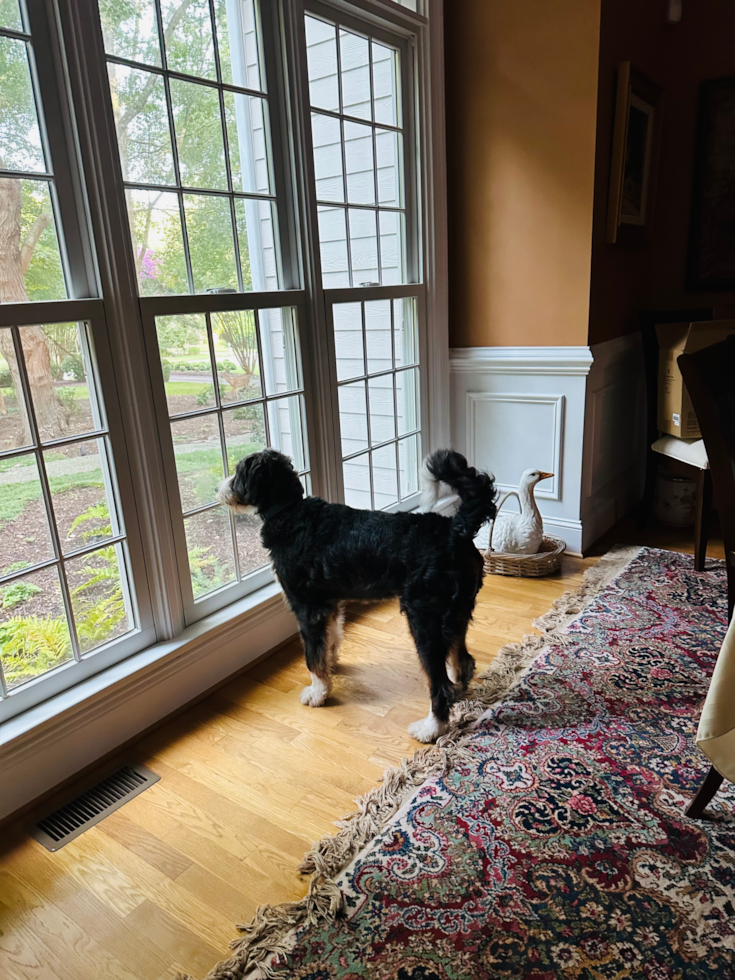
Mini Bernedoodles can bark when left alone, but the reason behind the barking matters a lot. Some dogs bark briefly for a minute or two after their owner leaves and then settle normally. Others struggle more significantly because the isolation feels emotionally difficult rather than simply disappointing. Those are two very different situations, even though they may sound similar at first.
Because Mini Bernedoodles form strong attachments to their families, some become highly people-focused if independence is not encouraged early. Dogs that spend every moment near their owners without gradually learning how to relax alone sometimes struggle once separation finally happens. Barking becomes part of that stress response.
This does not mean Mini Bernedoodles are naturally unstable or incapable of staying alone. Many do perfectly well with healthy preparation, predictable routines, and gradual independence training. The issue usually develops when alone time arrives too suddenly or only happens after months of constant companionship. A dog that has never learned how to self-settle independently cannot magically understand it overnight just because someone returns to work on Monday morning.
It also helps to understand the difference between normal protest barking and separation anxiety. A dog that barks briefly after you leave but settles within a few minutes is usually expressing mild frustration or adjustment. A dog experiencing true separation distress shows more intense signs like nonstop barking, panic behaviors, pacing, destructive chewing, inability to relax, or escalating distress that continues long after the owner leaves.
Confidence-building plays a huge role here. Mini Bernedoodles handle alone time better when independence develops gradually from puppyhood onward. Short separations, quiet crate familiarity, structured naps away from constant interaction, calm departures, and opportunities to self-settle all help build emotional resilience over time.
Crate training can help many dogs as well when introduced positively and gradually. For some Mini Bernedoodles, a properly introduced crate creates predictability and security rather than restriction. The key is making the environment feel calm and familiar instead of using confinement only when owners leave the house. Dogs notice associations quickly.
Routine matters here too. Dogs that understand when rest happens, when interaction happens, and when their owners reliably return develop much healthier emotional balance around separation. Constantly emotional goodbyes, unpredictable schedules, or making the dog the center of attention every moment of the day can unintentionally increase dependency instead of confidence.
The encouraging part is that Mini Bernedoodles are highly trainable and emotionally responsive. Many separation-related barking issues improve significantly once dogs build confidence, predictability, and healthier independence skills. In most cases, the goal is not teaching the dog to “care less” about its family. It’s teaching the dog that being alone for a while is safe, manageable, and temporary.
RELATED: Are Mini Bernedoodles Smart? Intelligence, Trainability & Behavior
Do Mini Bernedoodle Puppies Bark More?

Yes, Mini Bernedoodle puppies bark more than adult dogs, especially during certain developmental stages. That does not automatically mean the puppy will grow into a noisy adult dog. In most cases, puppy barking reflects immaturity, overstimulation, frustration, curiosity, or temporary emotional phases rather than a permanent personality trait.
Puppies experience the world very differently than adult dogs. Everything feels new, intense, exciting, confusing, or overwhelming all at once. Sounds, visitors, separation, teething discomfort, sudden noises, unfamiliar environments, and even simple frustration during training can trigger barking more easily because puppies have not fully developed emotional regulation yet.
Fear periods are one of the biggest reasons some Mini Bernedoodle puppies suddenly become more vocal. During these stages, puppies react more strongly to unfamiliar sounds, movement, strangers, or environmental changes that previously seemed unimportant. Owners sometimes worry something is “wrong” because the puppy suddenly starts barking at shadows, hallway noises, or random objects outside the window. In many cases, the puppy is simply moving through a temporary developmental phase where the nervous system becomes more sensitive to the environment.
Teething can also increase barking and irritability. Puppies dealing with sore gums and physical discomfort become more reactive, frustrated, and emotionally sensitive. Some bark more during play, some become more demanding, and others struggle to settle calmly because discomfort lowers their tolerance for frustration.
Overstimulation is another huge piece of the puzzle, especially in intelligent breeds like Mini Bernedoodles. Puppies that stay awake too long, experience too much excitement, or move from one stimulating activity to another without enough rest become louder, wilder, and less emotionally controlled as the day goes on. A lot of owners assume the puppy needs more exercise when the puppy actually needs sleep.Young puppies need 18 to 20 hours of sleep per day. Without enough rest, they can become mouthier, barkier, more impulsive, more reactive, and dramatically worse at settling themselves. An overtired Mini Bernedoodle puppy can go from sweet and calm to emotionally unhinged over something as minor as someone walking past the living room window.
Attention-seeking phases are common too. Mini Bernedoodles learn quickly, including how humans respond to noise. Puppies naturally experiment with behaviors that create interaction. Barking at people during dinner, barking during work calls, barking while someone prepares food, or barking to continue play often starts as simple experimentation before becoming habit.
Adolescence usually brings another temporary increase in barking as well. Mini Bernedoodles become more vocal between roughly 6 months and 18 months old because hormones, confidence changes, environmental awareness, and emotional impulsivity all increase during this stage. Dogs that previously ignored certain sounds may suddenly bark at everything for a while. Training can feel inconsistent. Emotional reactions become bigger. Focus disappears randomly. Owners describe this stage as feeling like their puppy “forgot everything overnight.”
The encouraging part is that many Mini Bernedoodles calm significantly with maturity. Puppies are not finished versions of themselves yet. A barky adolescent does not automatically become a barky adult.
RELATED: Top 5 Things to Know Before Getting a Mini Bernedoodle Dog
At What Age Do Mini Bernedoodles Calm Down?

Most Mini Bernedoodles begin settling noticeably between 1.5 and 3 years old, although maturity can happen gradually rather than all at once. Many owners notice steady improvement in barking, impulsive behavior, emotional reactivity, and hyperactivity as the dog develops better self-regulation and emotional stability.
That said, “calming down” does not happen because a dog simply reaches a certain birthday and suddenly transforms into a peaceful adult overnight. Maturity helps, but structure matters just as much. Sometimes more.
Adolescence tends to be the hardest stage for many owners. During this period, Mini Bernedoodles become more emotionally reactive, more distractible, more vocal, and more impulsive even if they seemed relatively calm as younger puppies. Increased barking during adolescence is extremely common because dogs become more aware of their environment while still lacking the emotional control to process stimulation calmly.
This stage can feel frustrating because progress looks inconsistent. A dog that handled visitors calmly at five months may suddenly bark excessively at guests at ten months. A puppy that settled quietly before may begin demand barking for attention or reacting to outdoor noises much more intensely. In many cases, this reflects temporary developmental changes rather than permanent behavior problems.
Genetics influence maturity too. Some Mini Bernedoodles naturally lean calmer and emotionally steadier from an early age. Others stay more sensitive, excitable, or environmentally alert well into adulthood. Lifestyle and environment also shape how quickly dogs learn to regulate themselves.
Dogs raised with stable routines, consistent boundaries, gradual exposure, healthy independence training, and enough mental engagement settle more smoothly over time because emotional regulation becomes part of daily life rather than something the dog must figure out alone.
Training plays a major role here as well. Dogs do not automatically learn how to settle calmly indoors just because they grow older. Calmness is reinforced through routines, rest, predictability, confidence-building, and consistent responses from the people around them. A dog that constantly lives in a state of overstimulation, inconsistency, or emotional over-arousal may continue struggling with barking and impulsive behavior far longer than a dog taught how to relax and self-settle early on.
Some Mini Bernedoodles calm down beautifully once owners stop focusing only on physical exercise and start supporting the dog’s mental and emotional needs more intentionally. Endless excitement does not always create calmer dogs. Sometimes it creates dogs that stay emotionally “amped up” all the time.
RELATED: See Adorable Mini Bernedoodle Puppies
Are Mini Bernedoodles Good Apartment Dogs?

Mini Bernedoodles can adapt very well to apartment living. Their success in apartments depends more on routine, mental stimulation, training, and emotional balance than the size of the living space itself. A well-adjusted Mini Bernedoodle in an apartment behaves more calmly than an under-stimulated dog living in a large house with unlimited backyard access.
That surprises a lot of people because bigger homes do not automatically create calmer dogs. In many cases, dogs still spend most of their time near their people regardless of how much square footage exists around them. What matters more is whether the dog feels mentally engaged, emotionally secure, and capable of settling indoors without constantly searching for stimulation.
The biggest apartment challenge for many Mini Bernedoodles is noise exposure rather than lack of space. Apartment living naturally creates more unpredictable environmental sounds. Hallway footsteps, elevators, neighboring dogs, doors opening and closing, voices outside the unit, delivery activity, and sudden movement near windows can all trigger alert barking if a dog becomes overly focused on monitoring the environment.
Some Mini Bernedoodles adjust to these sounds quickly and barely react after the first few weeks. Others stay highly alert to every little change happening around them, especially during adolescence or if they already lean more sensitive by temperament. That is where training and routine start mattering a lot.
Alert barking management is especially important in apartment settings because dogs quickly learn which sounds feel important and which ones can safely fade into the background. Calm exposure, consistent responses, confidence-building, and teaching the dog how to disengage from environmental triggers make a huge difference over time. Dogs that spend all day staring out windows waiting for stimulation usually become much more reactive than dogs with structured routines and healthy mental outlets.
Daily engagement matters enormously here. A Mini Bernedoodle that receives meaningful interaction, sniff-heavy walks, training sessions, enrichment activities, and enough rest settles surprisingly well indoors. On the other hand, a dog left mentally under-stimulated in a small apartment all day may begin barking at hallway noise, neighboring dogs, outside movement, or literally nothing identifiable just to release mental frustration and energy.
This is why boredom tends to create more apartment problems than square footage itself. Intelligent dogs create their own stimulation when nothing else fulfills them, and apartment environments provideendless opportunities for environmental monitoring if dogs are not taught how to relax and self-settle.
Dogs that know when walks happen, when quiet time happens, when enrichment happens, and when rest happens adjust much more smoothly to apartment life because the environment is predictable rather than chaotic.
The good news is that Mini Bernedoodles genuinely thrive in apartments when their emotional and mental needs are supported consistently. They are people-oriented dogs that prefer being close to their families anyway. With enough engagement, structure, and training, they become calm indoor companions.
RELATED: Are Mini Bernedoodles Good Family Dogs? What Life Really Looks Like
Signs Barking Is Becoming a Real Problem

Occasional barking is completely normal for Mini Bernedoodles. A few alert barks when someone knocks at the door, brief excitement barking before a walk, or reacting temporarily to unusual sounds does not automatically mean anything is wrong. The real concern comes from intensity, frequency, emotional escalation, and a dog’s inability to disengage once barking starts.
One of the clearest warning signs is nonstop window barking or environmental monitoring that consumes large portions of the day. Dogs that constantly patrol windows, react to every passing sound, or stay “on alert” for hours at a time struggle to relax their nervous system fully. Over time, that constant state of hyper-awareness can make barking stronger and more automatic.
Panic barking during separation is another sign that the issue may go beyond normal communication. A dog that barks briefly after an owner leaves and then settles is very different from a dog that spirals into prolonged distress every time isolation happens. Barking paired with pacing, destructive chewing, frantic movement, drooling, or inability to settle usually points toward emotional overwhelm rather than simple attention-seeking.
Another important sign is the inability to settle indoors even after physical activity and engagement needs appear met. Some dogs stay emotionally overstimulated long after the exciting moment passes. They bark at small sounds repeatedly, react intensely to routine environmental triggers, or seem unable to “turn off” mentally even in calm settings.
Escalating reactivity deserves attention too. A dog that once ignored hallway sounds but now barks aggressively at every noise, visitor, passing dog, or movement outside may be becoming increasingly sensitive rather than more confident. Barking that grows stronger, louder, or more emotionally charged over time usually signals that the underlying emotional state needs support instead of simply suppressing the noise itself.
Obsessive demand barking can become another problem pattern, especially in intelligent breeds like Mini Bernedoodles. Dogs that bark constantly for attention, interaction, food, play, or access to certain spaces sometimes become stuck in a cycle where barking controls much of the household dynamic. In these situations, the issue is usually not the barking alone. It is the dog’s growing inability to tolerate frustration or settle independently without constant engagement.
Barking paired with pacing, whining, destruction, frantic energy, inability to rest, or constant environmental scanning tells a very different story than a dog giving one or two alert barks before relaxing again. The barking itself is only part of the picture. The emotional state underneath it matters just as much.
Barking problems rarely appear overnight. In most cases, they build gradually through patterns involving overstimulation, boredom, inconsistency, emotional dependency, lack of rest, or environmental stress. That means early adjustment makes a huge difference. Dogs usually improve far more when owners focus on emotional balance, confidence-building, mental engagement, and calm routines instead of only trying to stop the sound itself.
RELATED: 10 Common Dog Training Mistakes To Avoid
Do Male or Female Mini Bernedoodles Bark More?

There is no guaranteed “quieter” gender when it comes to Mini Bernedoodles. Individual temperament almost always matters far more than whether the dog is male or female. Genetics, emotional sensitivity, confidence, training, routine, socialization, and environment usually influence barking behavior much more strongly than gender alone.
That said, some owners notice subtle personality differences between males and females. Male Mini Bernedoodles sometimes come across as slightly more attention-seeking or socially dependent, especially during adolescence. In some dogs, that can translate into more excitement barking, demand barking, or vocal behavior tied to interaction and engagement.
Females sometimes appear to mature emotionally a bit faster, which may help certain dogs settle earlier indoors. Some owners describe female Mini Bernedoodles as slightly more independent or more naturally self-regulated during adolescence, although personality varies enormously from dog to dog.
It’s important not to turn these tendencies into hard rules because plenty of female Mini Bernedoodles are highly vocal and intense, while many males are calm, quiet, and easygoing. Temperament exists on an individual spectrum, not a strict male-versus-female divide.
A confident, mentally balanced male raised with healthy routines and consistent training will usually bark less than an anxious or under-stimulated female struggling with emotional regulation. The opposite can also be true.
For most families, choosing between a male or female Mini Bernedoodle should focus more on overall personality fit, energy level, emotional balance, and lifestyle compatibility rather than trying to predict barking behavior alone.
Final Thoughts: Do Mini Bernedoodles Bark a Lot?

Mini Bernedoodles are not excessive barkers by nature. They are expressive, emotionally aware dogs that tend to bark when something feels important, exciting, frustrating, or emotionally significant to them. That is very different from a breed that barks constantly without much connection to what is happening around them.
What makes Mini Bernedoodles unique is how closely their behavior reflects the life built around them. Dogs that receive structure, companionship, mental engagement, routine, healthy independence training, and consistent guidance usually develop into calm, adaptable companions that settle surprisingly well indoors. Dogs that feel chronically overstimulated, bored, emotionally dependent, or mentally under-engaged struggle more with barking because smart dogs rarely keep unmet needs completely hidden.
That does not mean owners need to create a perfectly structured life every single day to have a well-behaved dog. Real life is messy. Schedules change. Puppies go through difficult phases. Adolescence can feel chaotic for a while. Some barking is simply part of living with an intelligent, emotionally responsive breed.
The important thing is recognizing the difference between normal communication and behavior that signals the dog is struggling to regulate itself emotionally. In many cases, barking improves significantly once the underlying cause becomes clear. Sometimes the dog needs more mental engagement. Sometimes better rest. Sometimes clearer routines. Sometimes confidence-building and independence work. Often, it’s a combination of small things adding up over time rather than one major problem.
Mini Bernedoodles are highly trainable dogs, and many mature beautifully with consistency and experience. The loud, impulsive adolescent that barks at hallway noise, spins in circles before walks, and loses emotional stability every evening at 8 p.m. becomes a much calmer adult once maturity, structure, and emotional regulation start catching up with all that intelligence and sensitivity.
So, do Mini Bernedoodles bark a lot? Usually no, at least not compared to truly high-vocal breeds. But they are emotionally engaged dogs that pay close attention to the world around them. When their mental and emotional needs are balanced, they become affectionate, calm companions that fit naturally into everyday family life without turning the house into a nonstop noise festival.
Elena R.
About The Author
Elena is a leading expert in the field of dog behavior, care, and training, with over a decade of experience in writing about dogs. As a published writer and lifelong dog enthusiast, Elena currently shares her home with three beloved canine companions. She is dedicated to staying up to date on the latest advancements in dog care and training, ensuring that her articles provide readers with accurate and valuable insights. With her extensive knowledge and passion for all things canine, Elena's contributions to the Premier Pups community offer both expertise and authority on a wide range of dog-related topics.
What To Read Next

Are Mini Bernedoodles Aggressive? What Owners and Experts Say
Mini Bernedoodles have a reputation that precedes them. Fluffy, affectionate, deeply people-oriented — the kind of dog that greets every visitor like a long-lost friend and considers your lap a permanent reservation.
Mini bernedoodles are not an aggressive... Read More

Mini Bernedoodle Pros and Cons
Mini Bernedoodles have become one of the most talked-about doodle breeds in recent years. It’s easy to understand why. They’re fluffy, expressive, affectionate, and kind of hard to ignore once you spend time around one. A lot of people picture the perfect... Read More
Frequently Asked Questions
Do Mini Bernedoodles bark at strangers? Some do, especially during adolescence or when they feel uncertain about unfamiliar people entering the home. Most Mini Bernedoodles are not naturally aggressive toward strangers, but many are observant dogs that alert bark when someone approaches the house or enters their space unexpectedly. Early socialization, confidence-building, and calm introductions usually help reduce excessive stranger-related barking over time.
Why does my Mini Bernedoodle bark so much? Excessive barking usually happens for a reason. Common causes include boredom, overstimulation, frustration, alert behavior, attention-seeking, anxiety, lack of mental stimulation, inconsistent routines, or difficulty settling independently. The barking itself is less important than the emotional state driving it. Understanding why the dog is barking matters more than simply trying to silence the behavior.
Do Mini Bernedoodles bark at strangers? Some do, especially during adolescence or when they feel uncertain about unfamiliar people entering the home. Most Mini Bernedoodles are not naturally aggressive toward strangers, but many are observant dogs that alert bark when someone approaches the house or enters their space unexpectedly. Early socialization, confidence-building, and calm introductions usually help reduce excessive stranger-related barking over time.
Are Mini Bernedoodles yappy? Mini Bernedoodles are not considered yappy dogs. They tend to bark with purpose rather than barking nonstop throughout the day. However, highly intelligent and emotionally sensitive dogs can become more vocal if they feel under-stimulated, anxious, overtired, or overly reactive to their environment.
Do Mini Bernedoodles bark more than Goldendoodles? It depends more on individual temperament than breed alone. Some Mini Bernedoodles may appear slightly more observant or environmentally sensitive, while some Goldendoodles may lean more socially outgoing and excitable. Both breeds can develop barking habits if mental stimulation, training, and emotional regulation are lacking.
Can Mini Bernedoodles live in apartments? Yes, Mini Bernedoodles adapt very well to apartment living when they receive enough mental engagement, routine, exercise, and training. Barking management is especially important in apartments because hallway noise, neighboring dogs, and environmental sounds can trigger alert barking in sensitive dogs. Calm routines and confidence-building make a huge difference.
Do Mini Bernedoodles bark when left alone? Some do, especially if they struggle with separation or have never learned how to settle independently. Mild protest barking for a few minutes after owners leave is fairly common in young dogs. More intense barking that continues for long periods may point toward separation-related stress or emotional dependency. Mini Bernedoodles improve significantly with gradual independence training and predictable routines.
Are Mini Bernedoodles prone to separation anxiety? Mini Bernedoodles can become very attached to their families, which means some may be more vulnerable to separation-related stress if independence is not developed gradually. This does not mean the breed is naturally unstable or anxious. Many do perfectly well alone when they build confidence, emotional balance, and healthy routines from an early age.
How do I stop my Mini Bernedoodle from barking? The most effective approach depends on why the barking is happening. Dogs barking from boredom need more mental enrichment, while dogs barking from anxiety need confidence-building and emotional support. Calm consistency, structured routines, mental stimulation, impulse control training, and teaching settling behaviors help far more than punishment or constant correction alone.
Do Mini Bernedoodle puppies bark more than adults? Usually yes. Puppies bark more during teething, fear periods, frustration phases, overstimulation, and adolescence because emotional regulation is still developing. Many calm significantly with maturity, structure, sleep, and consistent training.
At what age do Mini Bernedoodles calm down? Mini Bernedoodles begin settling noticeably between 1.5 and 3 years old. Adolescence temporarily increases barking, impulsive behavior, and environmental reactivity before emotional maturity develops more fully. Training, routine, mental stimulation, and emotional regulation all influence how quickly dogs settle.
Are male or female Mini Bernedoodles quieter? Neither gender guarantees quieter behavior. Individual temperament matters much more than gender alone. Some males may appear slightly more attention-seeking, while some females may mature emotionally a bit faster, but barking behavior usually depends more on personality, environment, routine, training, and emotional stability.
Is barking a sign my Mini Bernedoodle is unhappy? Not always. Barking is a normal form of communication and reflects excitement, alertness, curiosity, or environmental awareness. The concern comes when barking becomes excessive, emotionally intense, obsessive, or paired with stress behaviors like pacing, inability to settle, or panic during separation.
Do Mini Bernedoodles bark for attention? Yes, many can learn attention-seeking barking if the behavior consistently creates interaction. Mini Bernedoodles are intelligent dogs that quickly notice patterns. If barking regularly leads to eye contact, play, treats, or responses from owners, some dogs begin using barking as a reliable strategy for engagement.
Are Mini Bernedoodles good for first-time owners? They can be excellent for first-time owners who are prepared for an intelligent, emotionally engaged dog that needs structure, mental stimulation, and consistent routines. Mini Bernedoodles are affectionate, trainable, and eager to bond with their families, but they do best with owners who are willing to invest time into training, emotional balance, and healthy daily habits.
Can training completely stop barking? No dog becomes completely silent, and barking itself is not inherently bad behavior. The goal is not eliminating barking entirely but helping the dog respond calmly and appropriately to the environment. Most Mini Bernedoodles can learn to bark less excessively with proper training, emotional regulation, mental engagement, and consistent routines.