





Published Monday, July 13, 2026 by Elena R. in New Puppy, Popular Dogs
If you’ve been researching Bernedoodles for more than fifteen minutes, you’ve probably already fallen into the generation rabbit hole. F1, F1B, multigen, furnished, unfurnished, low shedding, more hypoallergenic, more Bernese-like, more Poodle-like. At some point, people stop feeling like they’re choosing a dog and start feeling like they accidentally enrolled in a genetics course they never asked for.
So let’s simplify the most important part first. An F1 Mini Bernedoodle is a first-generation cross between a Bernese Mountain Dog and a Miniature Poodle. The “F1” simply means the dog comes directly from those two purebred parent breeds, making the puppy roughly 50% Bernese Mountain Dog and 50% Miniature Poodle.
Many owners specifically love F1 Mini Bernedoodles because they feel like the most balanced mix of both breeds. You still get the goofy, affectionate, deeply people-oriented personality Bernedoodles are known for, but without the dog feeling overwhelmingly Poodle-like or overwhelmingly Bernese either. Many F1s land somewhere beautifully in the middle.
That balance is part of why people become so attached to them. F1 Mini Bernedoodles develop strong bonds with their families, are highly socially engaged, and carry that lovable mix of emotional sensitivity, playfulness, intelligence, and occasional chaos that makes living with them feel very interactive. Some become velcro dogs that follow their people everywhere. Others are slightly more independent.
F1 Mini Bernedoodles are usually less predictable than later generations, especially when it comes to coat type, shedding, and certain personality traits. One puppy may develop a loose wavy fleece coat with minimal shedding. Another may inherit a straighter coat that sheds more heavily. Some mature into calm, emotionally steady companions relatively early. Others stay goofy, emotionally dramatic, and puppy-like much longer.
That unpredictability sometimes makes buyers nervous, especially people trying to choose the “best” Bernedoodle generation before bringing home a puppy. But unpredictability is not automatically a bad thing. In fact, for many owners, it's part of the appeal. F1 Mini Bernedoodles feel slightly more natural, varied, and unique compared to later generations bred for stronger consistency in coat and appearance.
This is probably the healthiest mindset going into the breed: instead of looking for a perfectly engineered dog with zero surprises, it helps to understand what living with an F1 Mini Bernedoodle really feels like. The emotional attachment, the goofy personality, the intelligence, the grooming realities, the occasional stubborn streak, the deep social connection, the adolescence chaos nobody warns you about enough…all of those pieces matter much more long term than choosing the theoretically “perfect” generation on paper.
Table of Contents
- What Is an F1 Mini Bernedoodle?
- F1 Mini Bernedoodle Appearance – What Do F1 Bernedoodles Look Like
- F1 Mini Bernedoodle Size Full Grown
- F1 Mini Bernedoodle Temperament – What Are F1 Bernedoodles Like?
- Are F1 Mini Bernedoodles Good Family Dogs?
- Are F1 Mini Bernedoodles Easy to Train?
- Do F1 Mini Bernedoodles Shed?
- Are F1 Mini Bernedoodles Hypoallergenic?
- F1 Mini Bernedoodle Grooming Needs
- F1 Mini Bernedoodle Energy Levels
- Do F1 Mini Bernedoodles Bark a Lot?
- F1 Mini Bernedoodle vs F1B Mini Bernedoodle
- At What Age Do F1 Mini Bernedoodles Calm Down?
- Is an F1 Mini Bernedoodle Right for You?
What Is an F1 Mini Bernedoodle?
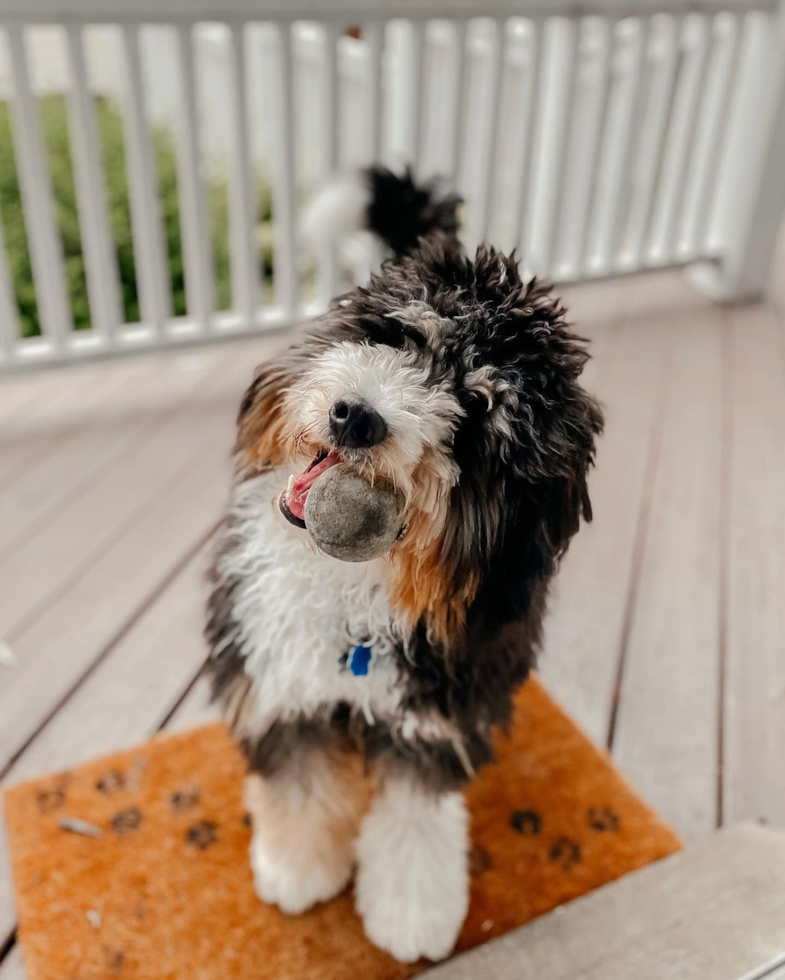
An F1 Mini Bernedoodle is a first-generation cross between a Bernese Mountain Dog and a Miniature Poodle. The “F1” simply means the puppy comes directly from those two parent breeds rather than from two Bernedoodles bred together. In most cases, that creates a dog that is roughly 50% Bernese Mountain Dog and 50% Miniature Poodle.
The “Mini” part comes from the Miniature Poodle side. Bernese Mountain Dogs are large working dogs, so the smaller adult size in Mini Bernedoodles comes from pairing the Bernese with a Miniature Poodle instead of a Standard Poodle.
This first-generation pairing is important because F1 Mini Bernedoodles show the widest variation in the entire Bernedoodle world. Coat texture, shedding levels, size, energy level, emotional intensity, and even appearance can vary noticeably from one puppy to another, sometimes even within the same litter. That variation is one reason some people avoid F1s. It is also exactly why many people specifically seek them out.
A lot of owners feel F1 Mini Bernedoodles capture the most balanced blend of both breeds. Many inherit the affectionate, emotionally connected personality people love in Bernese Mountain Dogs while also carrying the intelligence, athleticism, and trainability associated with Poodles. The result feels very “Bernedoodle” in the way people imagine the breed before they ever bring one home.
At the same time, no two F1 Mini Bernedoodles are exactly alike. One puppy may inherit a stronger Poodle personality with higher alertness, tighter curls, and endless mental energy. Another may lean much more Bernese-like with a calmer demeanor, stockier build, straighter coat, and softer emotional presence. Some feel like perfect middle-ground combinations of both breeds.
F1 Mini Bernedoodle Appearance – What Do F1 Bernedoodles Look Like
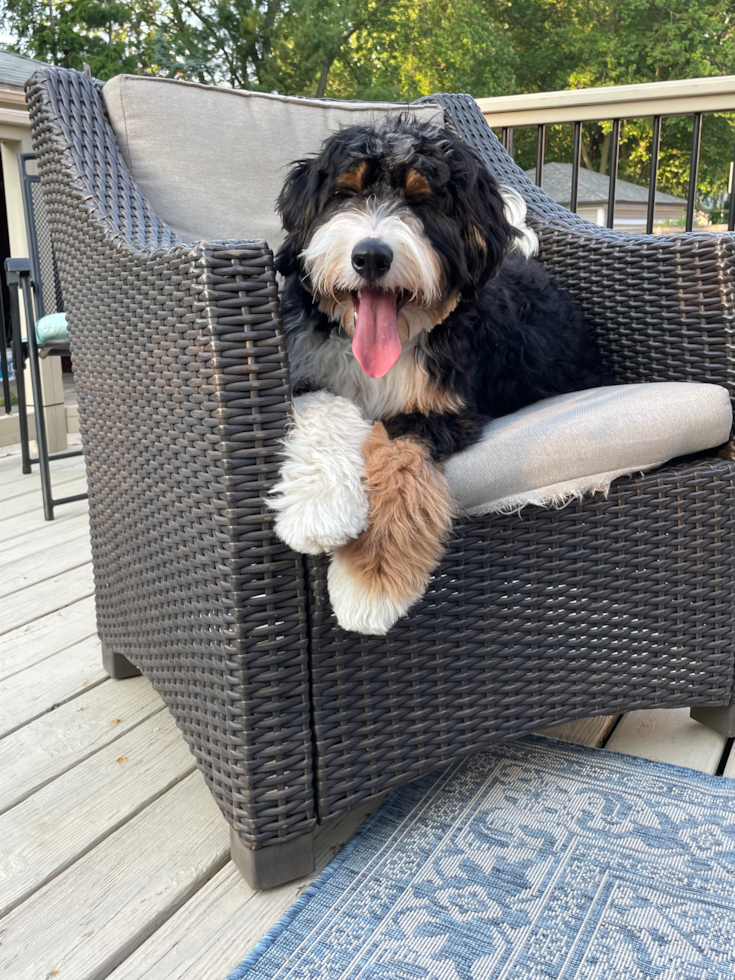
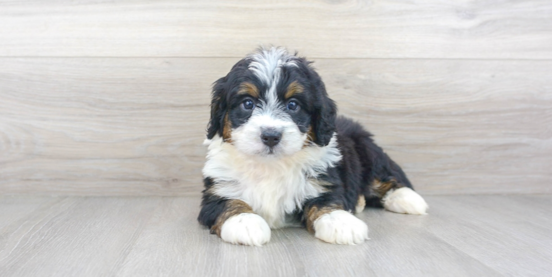
F1 Mini Bernedoodles are described as teddy bear dogs, but the way that “teddy bear” look appears can vary dramatically from one puppy to another. Some develop loose wavy fleece coats with soft rounded faces and expressive eyes that look almost exactly like the doodle image most people picture in their heads. Others inherit straighter coats, stronger Bernese features, or tighter curls that shift their appearance in a completely different direction.
The visual unpredictability is one of the defining characteristics of the F1 generation.
Some F1 Mini Bernedoodles inherit more Poodle influence physically. These dogs may develop curlier coats, narrower facial structure, longer legs, and a more refined athletic appearance. Others lean more heavily toward the Bernese Mountain Dog side with broader builds, stockier frames, heavier facial features, and straighter or fluffier coats. Most land somewhere between the two.
Wavy fleece coats are probably the most common and most sought-after look in F1 Mini Bernedoodles. These coats create the soft shaggy teddy bear appearance many families specifically want. Wavy coats shed less than straighter coats while still keeping a slightly more relaxed natural texture compared to very curly Poodle-heavy coats.
Straight coats happen too, and this surprises some buyers who assume every Bernedoodle automatically develops curls. Straighter-coated F1s look more Bernese-like and may shed more heavier than curlier dogs. Their coats can still be beautiful, especially for owners who want a softer natural look with slightly lower grooming intensity.
Curly coats also appear regularly in F1 Mini Bernedoodles, especially when stronger Poodle coat traits come through genetically. These dogs inherit tighter curls, denser coats, and lower shedding potential, although grooming demands usually increase significantly as curl density increases.
Facial furnishings make a big visual difference too. Furnishings refer to the longer facial hair around the muzzle, eyebrows, and beard area that gives doodles their signature teddy bear expression. Most F1 Mini Bernedoodles inherit furnishings to some degree, but the amount of facial fluff can vary noticeably from dog to dog.
Color and markings vary widely as well. Many F1 Mini Bernedoodles inherit classic Bernese-style tri-color markings with black, white, and rust tones, but the placement and intensity of those markings differ. Some F1 Mini Bernedoodle puppies develop very bold Bernese patterns, while others inherit softer abstract markings, parti coloring, merle patterns, or more solid coat appearances depending on genetics.
Eye color usually stays within brown shades, though depth and expression can vary dramatically. Some dogs inherit softer rounder Bernese-style eyes, while others develop a sharper more alert Poodle expression that changes the entire feel of the face.
This is one reason people become so attached to F1 Mini Bernedoodles visually. They rarely feel cookie-cutter. Even within the same litter, you can end up with puppies that look surprisingly different from one another in coat texture, build, markings, facial expression, and overall presence.
RELATED: See Mini Bernedoodle Customer Photos
F1 Mini Bernedoodle Size Full Grown
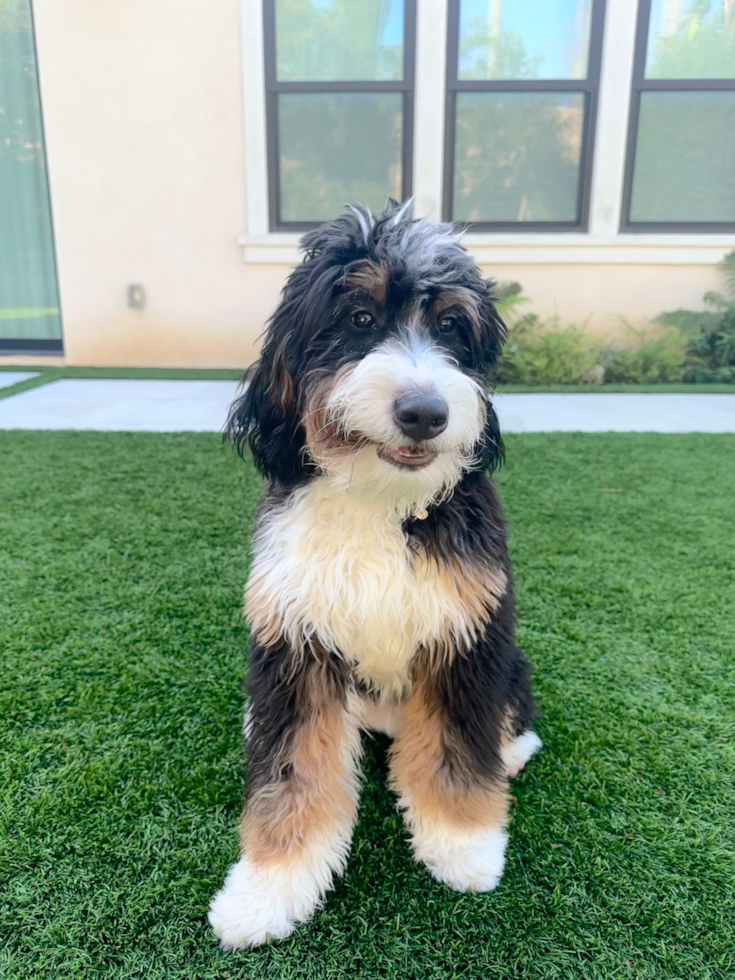
Most full-grown F1 Mini Bernedoodles fall somewhere between 25 and 50 pounds, although some stay smaller and others grow larger depending on genetics. Height usually lands around 18 to 22 inches at the shoulder for many adults, but there is more variation in F1s compared to later generations bred for tighter size consistency.
F1 Mini Bernedoodle size depends heavily on the parents themselves. The Miniature Poodle parent plays a major role in keeping the dog within the mini range, but the Bernese Mountain Dog side still brings large-breed genetics into the equation.
Parent size usually tells you far more than internet averages ever will. A puppy from smaller Bernese and Mini Poodle lines may mature into a compact 25-to-30-pound adult, while another F1 from larger lines may push well into the 45-to-50-pound range with a taller frame and heavier structure.
Males grow slightly taller and heavier than females, but the differences are usually modest. Male F1 Mini Bernedoodles may carry a broader frame and fuller build, while females sometimes stay a little narrower and lighter physically. Personality tends to feel much more noticeable than the size difference once the dog matures.
Growth happens quickly during the first year, especially during the early puppy months. Many F1 Mini Bernedoodles reach most of their adult height by around 10 to 12 months old, but physical maturity continues developing well beyond that stage. Adolescence creates awkward growth phases where legs suddenly look too long, paws seem oversized, or the dog temporarily resembles an emotionally chaotic creature trying to figure out how its own body works. Which, to be fair, is not entirely inaccurate.
Body filling and muscular development usually continue between 12 and 24 months, sometimes longer in larger individuals. This is one reason many adolescent F1 Mini Bernedoodles look lankier and leaner before eventually developing a fuller adult structure.
Coat also changes the perception of size dramatically. A fluffy wavy-coated F1 can look significantly larger than a straighter-coated dog with the exact same weight. Some owners become convinced their dog “grew overnight” after a grooming appointment simply because the coat stopped creating optical illusions.
This broader size variation is simply part of the F1 generation. Later Bernedoodle generations are a bit more predictable because breeders selectively refine size and coat consistency over time. F1s still carry more natural variation from the original Bernese and Poodle pairing, which means no two adult dogs look exactly the same once fully grown.
F1 Mini Bernedoodle Temperament – What Are F1 Bernedoodles Like?
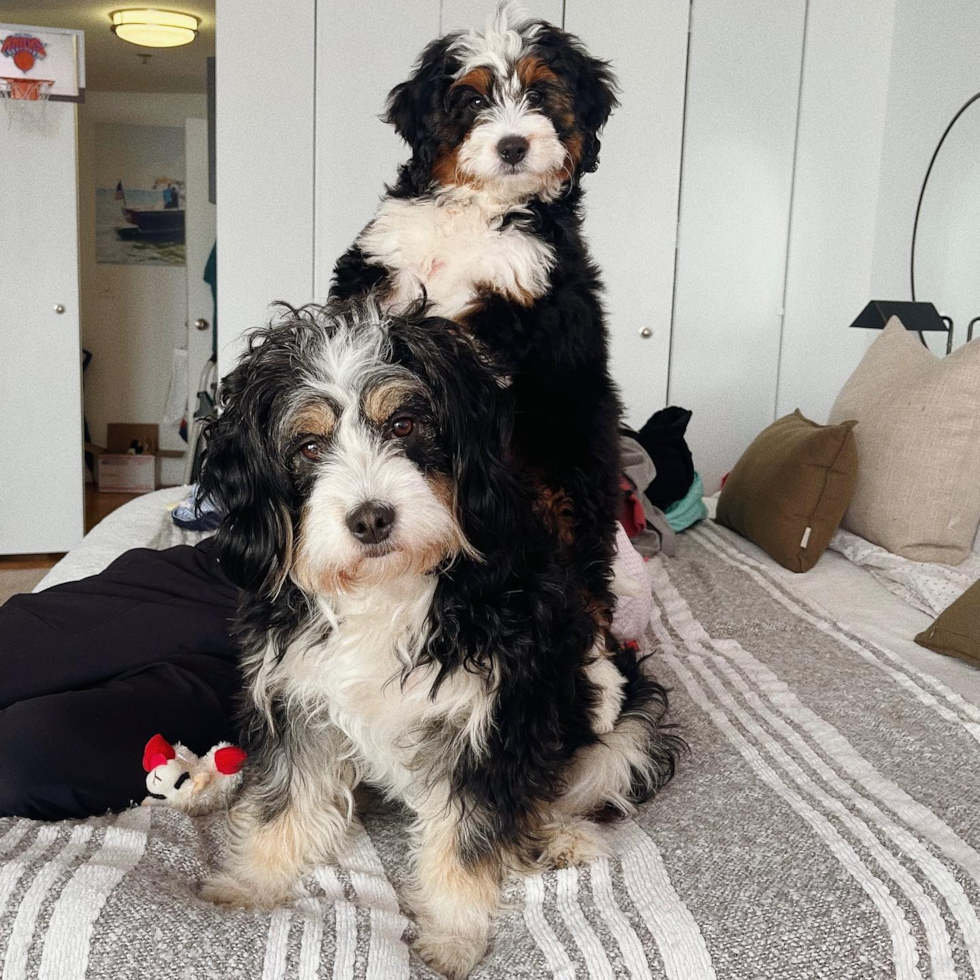
The F1 Mini Bernedoodle’s temperament is a huge part of why people fall so hard for this generation. These dogs are engaged with everything happening around them. Not just physically present in the house but genuinely involved in the rhythm of daily life.
F1 Mini Bernedoodles are affectionate, socially connected, playful dogs that bond very deeply with their families. They notice routines quickly, are highly aware of human emotion and household energy, and genuinely want to participate in whatever is happening around them, whether that means joining a hike, supervising dinner preparation, or monitoring someone folding laundry for reasons nobody fully understands.
That attachment can feel incredibly rewarding. It can also feel intense at times. Some F1 Mini Bernedoodles develop strong velcro dog tendencies and prefer to stay close to their people throughout the day. They seek interaction naturally, enjoy physical closeness, and become highly invested in household activity. Many owners describe them as emotionally expressive dogs that react visibly to excitement, stress, routine changes, visitors, and family energy in general.
This sensitivity is part of what makes the breed feel so socially intuitive. It is also why emotional regulation matters so much with F1 Mini Bernedoodles. Dogs that never learn how to settle independently or process stimulation calmly sometimes become overly reactive, attention-seeking, anxious, or overwhelmed because they absorb so much from the environment around them.
At their best, though, these dogs are deeply connected to family life in a way people remember very strongly. They are playful without feeling detached, intelligent without feeling cold, and socially engaged without losing that softer affectionate Bernese influence many people specifically want.
Goofy behavior appears constantly in owner discussions too. Many F1 Mini Bernedoodles stay playful and slightly ridiculous well into adulthood. Sudden zoomies, dramatic reactions, random bursts of excitement, exaggerated greetings, and generally chaotic enthusiasm seem to come naturally to a lot of them. Some mature into calmer adults relatively early. Others stay theatrical for years.
Trainability is usually very strong, especially when training is engaging and positive. F1 Mini Bernedoodles learn quickly because they are intelligent and socially motivated, but intelligence does not automatically equal effortless. Some become stubborn when overstimulated, distracted, or mentally under-engaged. Others learn patterns so quickly they accidentally train their owners right back.
Mental stimulation matters enormously here. A bored F1 Mini Bernedoodle rarely stays quietly bored for long. Intelligent, engaged dogs tend to create their own entertainment eventually, and owners do not always love the activities the dog chooses independently. Barking, attention-seeking, stealing objects, emotional chaos during adolescence, counter surfing, shadow-following behavior…these patterns appear when mental and emotional needs fall out of balance.
Are F1 Mini Bernedoodles Good Family Dogs?
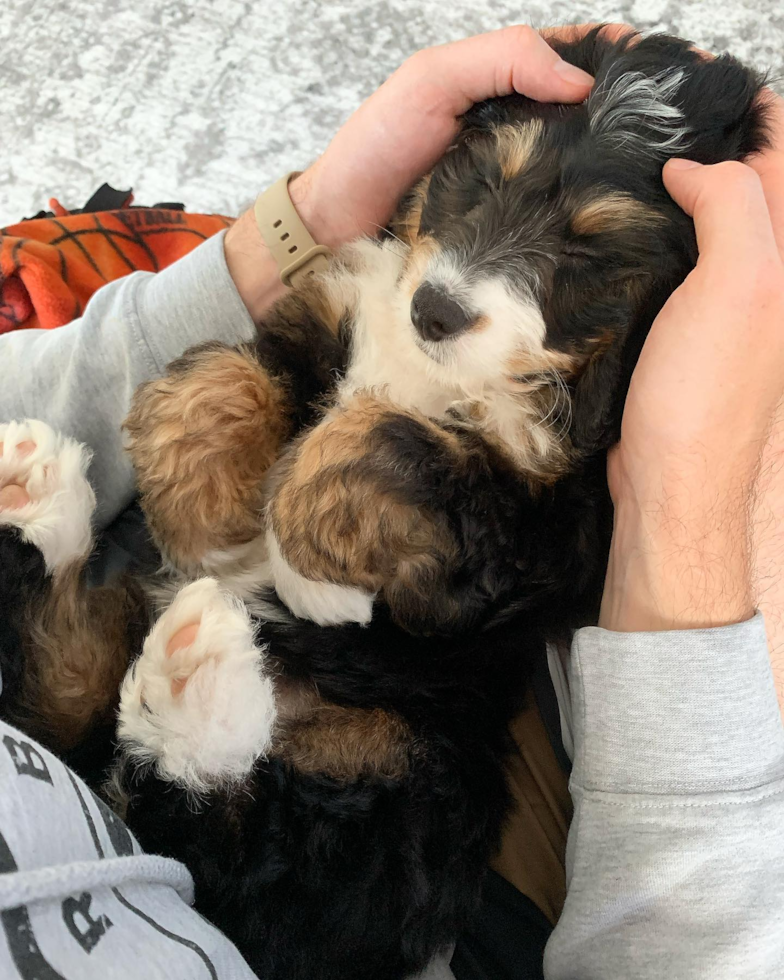
F1 Mini Bernedoodles do very well in family environments because they are socially connected, emotionally responsive, and highly people-oriented dogs. They genuinely enjoy being part of everyday household activity instead of simply existing around it passively. They want to participate in the energy of the home, whether that means playing with children in the yard, following family members from room to room, or inserting themselves directly into moments that did not technically require canine supervision.
A lot of families are drawn to the softer side of the breed. F1 Mini Bernedoodles develop strong attachment to their people and naturally seek closeness, interaction, and engagement throughout the day. That gentleness can create a very rewarding bond with children when the dog develops healthy confidence.
Playfulness is another major reason families love them. Most F1 Mini Bernedoodles carry a fun, socially engaging energy that fits naturally into active homes. They enjoy games, outdoor activity, training sessions, walks, and being involved wherever excitement is happening.
Because these dogs are sensitive and socially aware, household energy affects them quite a bit. Calm structure usually creates calm behavior. Chaotic overstimulation creates chaotic dogs. This is especially important in homes with younger children because constant excitement, loud noise, inconsistent boundaries, or nonstop interaction can overwhelm some dogs.
That does not mean F1 Mini Bernedoodles are fragile or difficult around children. It simply means regulation is important. Dogs that learn how to settle, recover from excitement, and process stimulation calmly usually integrate into family life much more smoothly.
Socialization and training shape this heavily too. Puppies exposed positively to children, handling, household sounds, routines, and structured interactions develop more confidence and flexibility as adults. Families that teach children respectful boundaries while also teaching the dog impulse control and calm behavior see the healthiest long-term dynamics.
Supervision still matters with young children, especially during puppyhood and adolescence. Even friendly dogs can become overly excited, jumpy, mouthy, or overstimulated during play simply because they are still developing self-control. A playful adolescent F1 Mini Bernedoodle has absolutely wonderful intentions while simultaneously behaving like a furry tornado. Most eventually settle into themselves beautifully with maturity, structure, and consistency.
RELATED: Are Mini Bernedoodles Good Family Dogs? What Life Really Looks Like
Are F1 Mini Bernedoodles Easy to Train?
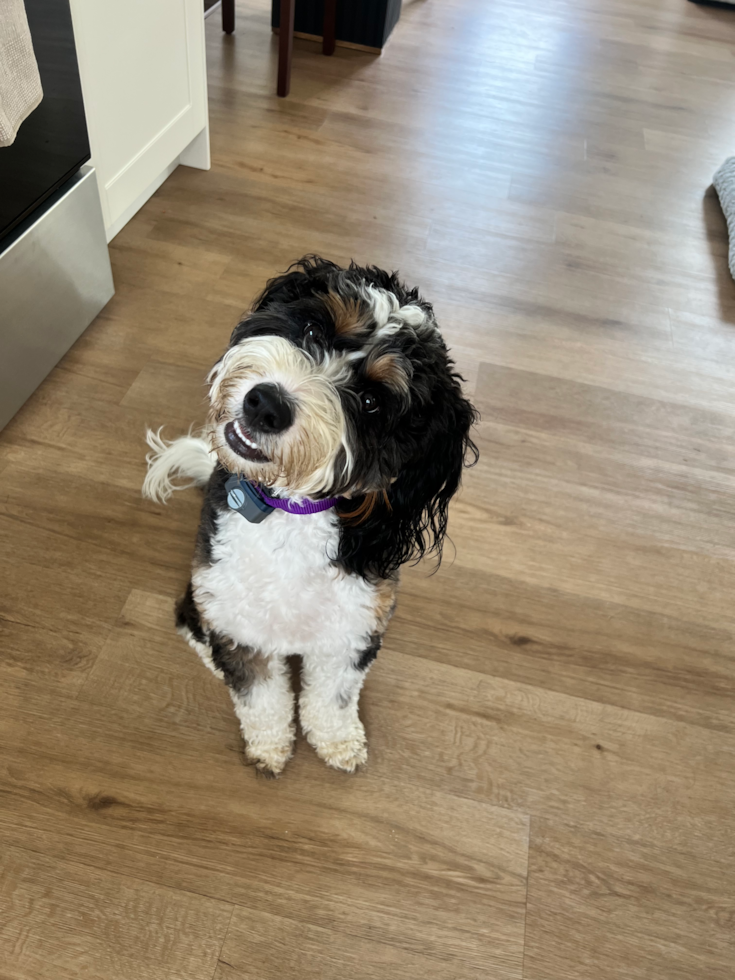
F1 Mini Bernedoodles are usually very intelligent and highly trainable dogs, especially when training feels engaging, structured, and positive to them. They learn patterns quickly, are socially motivated, and genuinely enjoy interaction with their people, which creates a strong foundation for training.
But intelligence alone does not automatically create an easy dog. In fact, highly intelligent dogs sometimes become harder to live with when structure disappears because they notice everything and develop habits quickly, including habits their owners never intended to teach. Intelligence without structure can create chaotic behavior surprisingly fast.
A lot of F1 Mini Bernedoodles are eager to participate during training sessions because they enjoy the engagement itself. They respond extremely well to positive reinforcement, praise, routine, and interactive learning. Harsh corrections or emotionally reactive training methods backfire with this breed because many F1s are emotionally sensitive and highly responsive to human energy. Dogs that feel confused, overwhelmed, or pressured sometimes shut down, become stubborn, or spiral into overstimulation instead of learning effectively.
Mental stimulation matters enormously too. These dogs can become restless, impulsive, or creatively destructive when their brains are under-engaged for too long. Training is not just about teaching commands with F1 Mini Bernedoodles. It is part of keeping that emotional balance. Short obedience sessions, enrichment games, sniff work, structured walks, and problem-solving activities usually help these dogs regulate themselves much more effectively.
Adolescence is where many owners suddenly question whether their previously brilliant puppy has temporarily lost all cognitive function. Focus weakens. Emotional impulses strengthen. Selective listening appears dramatically. A dog that mastered a command perfectly at six months old may suddenly act incapable of basic reasoning at ten months because excitement temporarily outranks logic in the nervous system.
This phase is extremely common, especially in intelligent breeds. And consistency matters heavily during these periods. F1 Mini Bernedoodles usually learn quickly when expectations are clear and routines are stable. Inconsistent boundaries, emotional reactions, or constantly changing rules create confusion because these dogs pay close attention to patterns within the household.
Stubbornness can appear too, although it looks different than traditional “hard-headed” breeds. Many F1 Mini Bernedoodles become stubborn when overstimulated, mentally bored, frustrated, or under-engaged rather than simply refusing to cooperate outright. Some know exactly what is being asked and just become too distracted to care in the moment.
RELATED: Are Mini Bernedoodles Smart? Intelligence, Trainability & Behavior
Do F1 Mini Bernedoodles Shed?
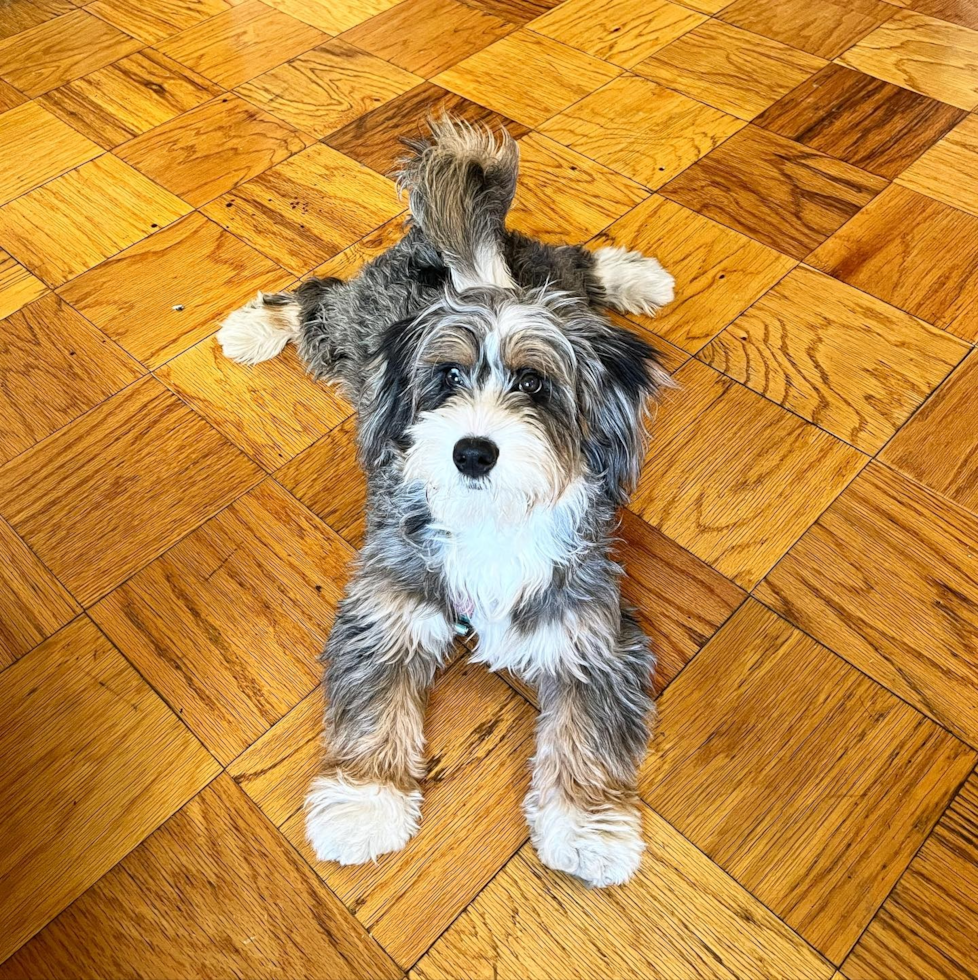
Yes, some F1 Mini Bernedoodles do shed, and the amount can vary quite a bit from one dog to another. This is one of the biggest differences between F1 Mini Bernedoodles and later generations like F1Bs, which are usually bred for more consistency in coat traits and lower shedding potential.
With F1s, coat genetics are simply less predictable. Some F1 Mini Bernedoodles inherit loose wavy fleece coats that shed very lightly and release minimal hair around the house. Others develop straighter coats that shed more noticeably, especially during seasonal coat changes or brushing. Some inherit curlier more Poodle-like coats that trap loose hair within the curls instead of releasing it onto furniture and clothing.
In general, straighter coats usually shed more. Wavy coats land somewhere in the middle with lighter shedding. Curly coats typically shed the least, although they also require the most grooming.
Facial furnishings matter too. Furnished coats are associated with lower shedding tendencies, while unfurnished or straighter-coated dogs may shed more similarly to traditional coated breeds.
But even then, there are no guarantees. This is the part many buyers underestimate when researching F1 Mini Bernedoodle shedding. Generation alone does not fully determine coat outcome. Two puppies from the same litter can develop noticeably different coats as adults. One may stay low shedding with a soft wavy texture, while another may release significantly more hair around the home despite sharing the same parents.
This is one reason some allergy-sensitive families eventually go with F1B Mini Bernedoodles instead. F1Bs inherit stronger Poodle coat influence, which increases coat consistency and lowers shedding potential. F1s still carry a wider range of possibilities genetically. It is also important to remember that no doodle is truly non-shedding. Some simply shed less than others. Even very low-shedding dogs still lose some hair naturally over time.
Shedding also changes depending on grooming, coat condition, seasonal shifts, and individual genetics. Puppies sometimes appear almost non-shedding initially before adult coat transitions reveal a different texture during adolescence. That coat transition phase surprises many first-time doodle owners because texture, density, and shedding patterns can all shift noticeably between roughly 8 and 18 months old.
RELATED: Do Mini Bernedoodles Shed? Coat Types and Allergies Explained
Are F1 Mini Bernedoodles Hypoallergenic?
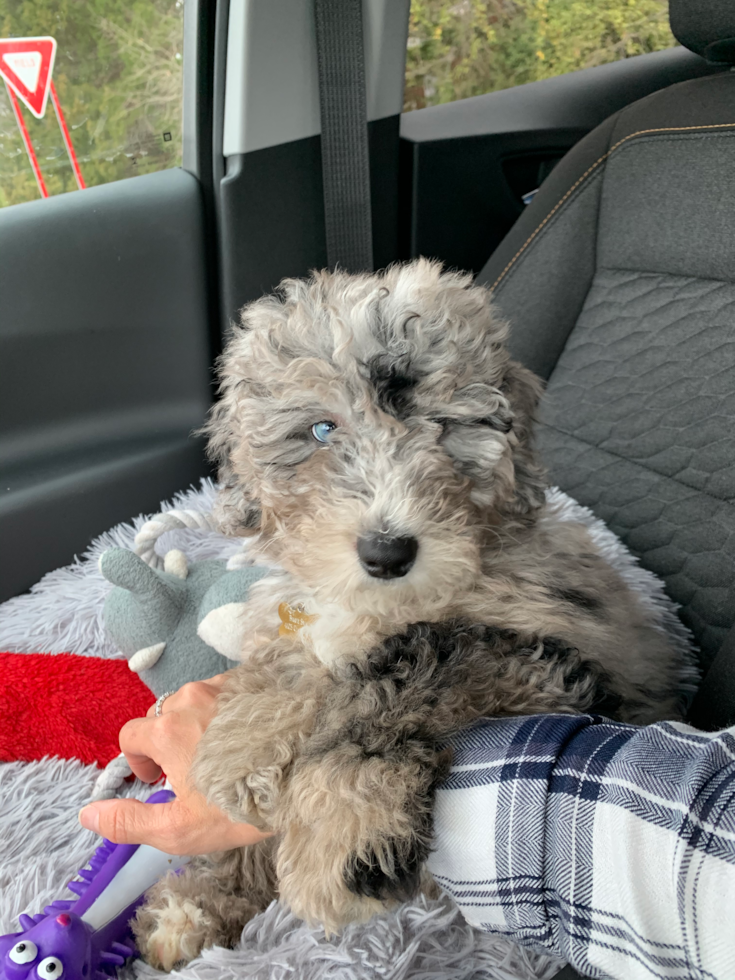
F1 Mini Bernedoodles are sometimes described as “hypoallergenic,” but the reality is more complicated than that. No dog is completely hypoallergenic, including doodles. Some dogs simply produce fewer allergy triggers for certain people depending on coat type, dander production, saliva proteins, and individual sensitivity levels.
This is especially important with F1 Mini Bernedoodles because coat variation is much wider in first-generation crosses. Some F1s inherit curlier low-shedding coats that may work reasonably well for people with mild allergies. Others inherit straighter coats that release more dander and loose hair into the environment, which can trigger reactions more easily.
Coat type plays a major role here. Curly coats trap more loose hair and dander within the coat itself instead of releasing it into the home. Wavy fleece coats perform fairly well too for some allergy-sensitive owners. Straighter coats typically create more allergy concerns because loose hair and dander spread more freely throughout the environment.
But coat texture is only part of the picture. Dog allergies are not caused by fur alone. Saliva, skin cells, dander, and natural proteins carried on the skin and coat all contribute to allergic reactions. That means even low-shedding dogs can still trigger allergies depending on the individual person’s sensitivity level. This is why some people react strongly to one doodle but barely react to another with a similar coat. Allergy experiences are highly individual.
For families with allergies, spending time around similar F1 Mini Bernedoodle coat types before committing to a puppy usually helps significantly. Meeting adults, interacting with dogs that have similar textures, or testing reactions in real environments provides much more useful information than relying entirely on internet labels like “hypoallergenic.”
RELATED: Are Mini Bernedoodles Hypoallergenic? Shedding, Allergies & More
F1 Mini Bernedoodle Grooming Needs
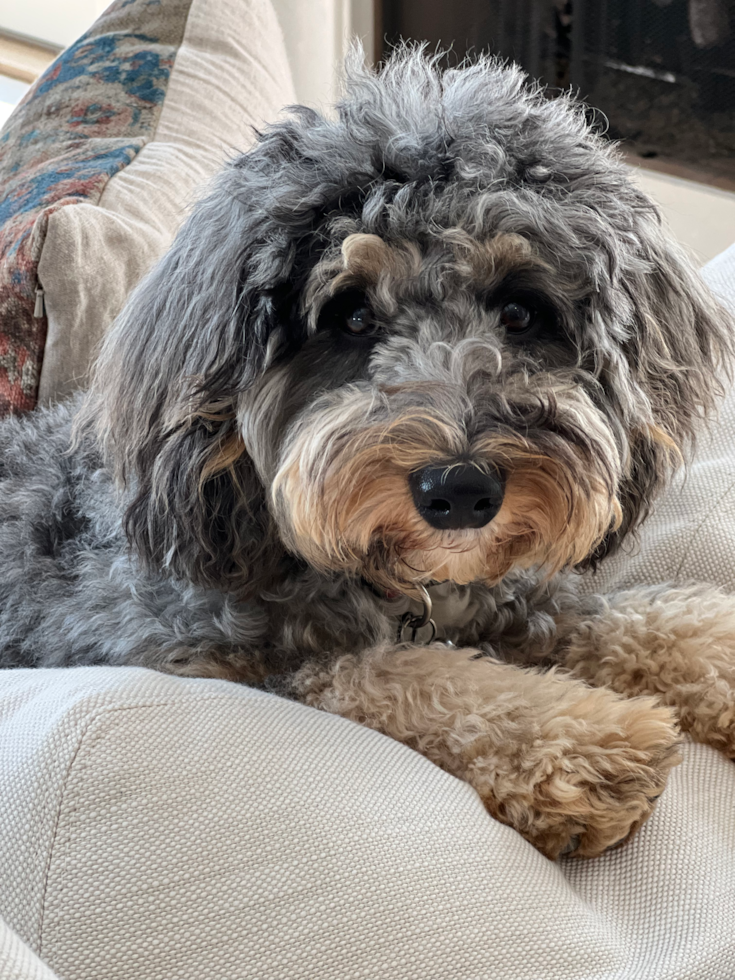
F1 Mini Bernedoodles require consistent grooming regardless of whether they shed lightly or moderately. This is one area where many first-time doodle owners get surprised because low shedding and low maintenance are absolutely not the same thing. In fact, the dogs that shed the least require the most coat upkeep.
Brushing is especially important once the adult coat starts developing during adolescence. F1 Mini Bernedoodles need brushing several times per week to prevent tangles, trapped debris, and matting from forming close to the skin. Curly coats require near-daily brushing in certain areas, while looser wavy coats may stay manageable with slightly less frequent maintenance.
Wavy fleece coats are considered the easiest balance for many families. They keep the soft shaggy Bernedoodle appearance people love and are somewhat easier to groom than very dense curly coats. Curly coats trap loose hair more effectively, which lowers visible shedding but also increases the risk of tight hidden mats forming underneath the surface if brushing is inconsistent.
Straighter coats need less intensive brushing, but they may shed more noticeably around the home. Coat texture changes the grooming experience quite a bit with F1 Mini Bernedoodles, which is one reason grooming conversations online sound completely contradictory between owners. People are living with very different coat types under the same breed label.
Matting can become a serious issue surprisingly fast when coat upkeep falls behind. Areas behind the ears, under the collar, around the legs, under the armpits, and near the tail tangle first because friction builds there constantly throughout the day. Small tangles can tighten into dense painful mats much faster than people expect, especially after swimming, humidity, snow, or inconsistent brushing routines.
Professional grooming is usually recommended every 6 to 10 weeks for most F1 Mini Bernedoodles depending on coat type and desired length. Some owners keep coats shorter for easier grooming, while others prefer fuller teddy bear styles that require more regular brushing and upkeep between appointments.
Ear care matters too because floppy ears can trap moisture and reduce airflow inside the ear canal. Regular ear cleaning and monitoring help reduce irritation and infection risk, especially for dogs that swim frequently or develop heavier facial and ear furnishings.
Bathing schedules vary depending on lifestyle and coat condition, but most F1 Mini Bernedoodles do best with occasional bathing rather than excessive washing. Overbathing can dry the skin and coat unnecessarily, while infrequent grooming sometimes allows debris, oils, and tangles to build up over time.
F1 Mini Bernedoodle Energy Levels
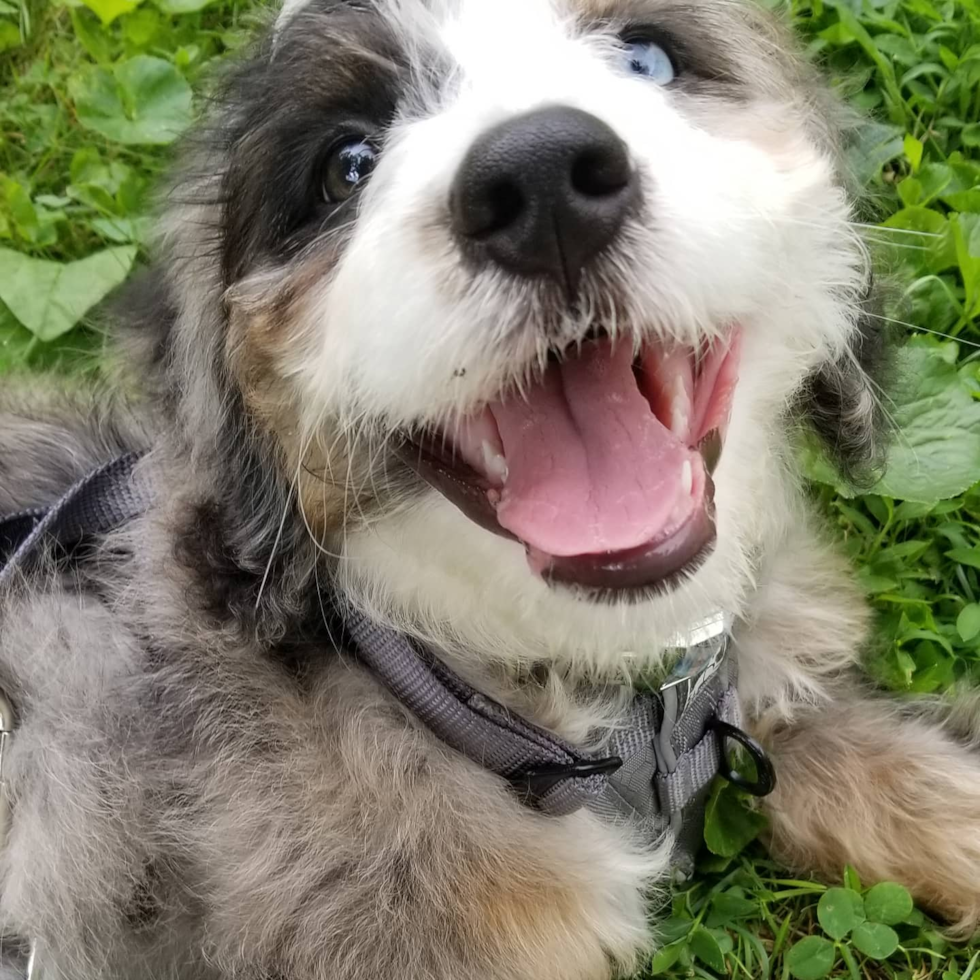
F1 Mini Bernedoodles fall into the moderate-to-high energy category, but the type of energy they carry matters just as much as the amount. These are engaged, mentally active dogs that need more than simple physical exercise to be content.
A lot of people assume exercise alone solves everything with intelligent breeds, but F1 Mini Bernedoodles become more chaotic from overstimulation and constant activity rather than calmer. Physical movement matters, of course, but mental stimulation and emotional regulation usually shape behavior just as heavily.
Sniff walks are a good example of this difference. A slower walk where the dog gets time to explore scents, process the environment, and engage mentally creates more calm afterward than endlessly trying to physically exhaust the dog through nonstop activity. Their brains need engagement just as much as their bodies do.
Training sessions help significantly, especially when they are interactive and mentally rewarding. F1 Mini Bernedoodles genuinely enjoy learning because they are socially connected dogs that like engaging with people directly. Short obedience sessions, puzzle toys, scent games, enrichment feeding, and problem-solving activities create a much more balanced dog.
Without enough mental engagement, these dogs sometimes create their own entertainment. And unfortunately, the dog’s idea of “productive hobbies” does not always align perfectly with the owner’s preferences. Attention-seeking behavior, barking, stealing objects, shadow-following, impulsive zoomies, and general chaos appear when intelligent dogs are mentally under-engaged for too long.
Emotional stimulation affects behavior heavily too. Some F1 Mini Bernedoodles become overstimulated very easily in busy environments with constant noise, excitement, movement, guests, children, or unpredictable routines. They absorb household energy quickly, which means teaching settling skills is just as important as exercise itself.
This is where many owners accidentally struggle. The dog learns how to play, run, react, and stay excited constantly, but never fully learns how to relax. Dogs that cannot settle stay “on” all day long, which gradually increases impulsive behavior, barking, frustration, and difficulty self-regulating indoors.
Structured downtime matters a lot with this breed. Calm routines, naps, predictable schedules, and quiet periods help F1 Mini Bernedoodles regulate themselves emotionally much more effectively long term.Most do not necessarily need a massive yard to thrive. What they need more is consistent engagement, balance, training, structure, and opportunities to use their brains regularly. A mentally satisfied F1 Mini Bernedoodle living in an apartment with healthy routines behaves far better than an under-stimulated dog running loose in a huge backyard with nothing meaningful happening mentally.
RELATED: Are Mini Bernedoodles High Energy? An Honest Look at Daily Life
Do F1 Mini Bernedoodles Bark a Lot?
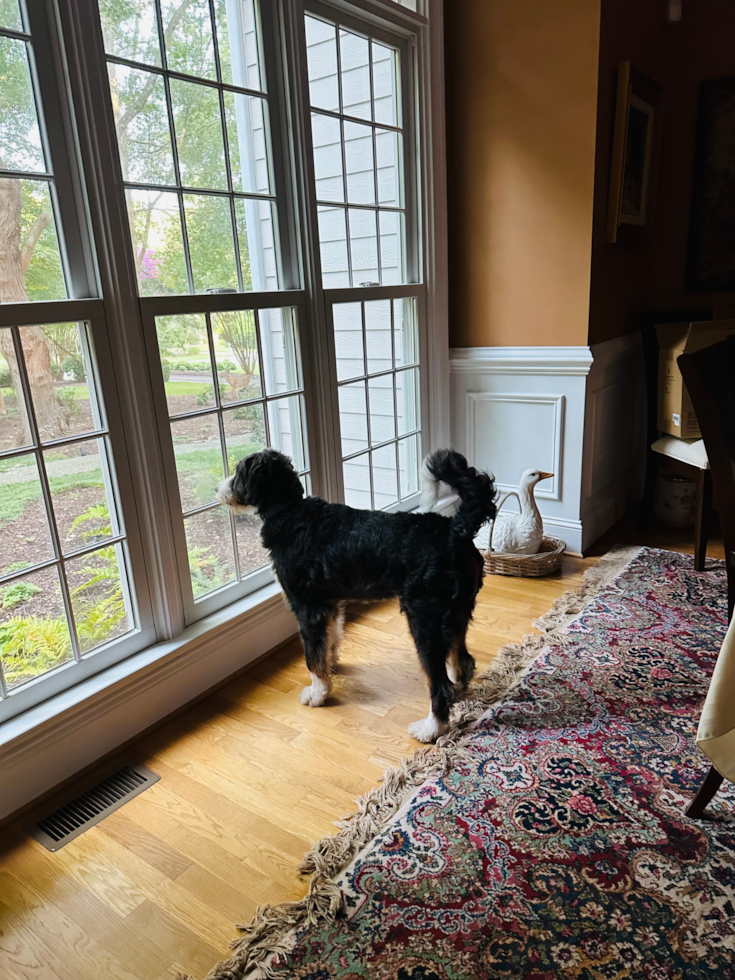
F1 Mini Bernedoodles are usually moderate barkers rather than excessively noisy dogs. Most bark for a reason instead of vocalizing constantly without much environmental or emotional trigger behind it. But because these dogs are so engaged and highly aware of their surroundings, barking behavior reflects what is happening internally just as much as what is happening externally.
Alert barking is probably the most common type owners notice. F1 Mini Bernedoodles pay close attention to movement outside windows, hallway sounds, unfamiliar visitors, passing dogs, delivery trucks, or changes in household activity. Their Bernese and Poodle genetics both contribute to environmental awareness, so many naturally want to “announce” that something new is happening nearby. That behavior is usually not aggression. In most cases, it is simply environmental responsiveness combined with a bit of natural sensitivity.
Attention-seeking barking can appear too, especially in highly people-oriented dogs that love interaction and engagement. Some F1 Mini Bernedoodles quickly learn that barking creates eye contact, movement, conversation, or activity from their owners. Intelligent dogs notice patterns fast and emotionally attached dogs experiment with whatever behaviors successfully restart engagement throughout the day.
Boredom barking is more likely when mental stimulation falls behind. These dogs are too intelligent and emotionally active to quietly entertain themselves forever without structured outlets. Dogs that feel mentally under-engaged create their own stimulation eventually, and vocal behavior sometimes becomes part of that process.
Routine helps a lot. F1 Mini Bernedoodles behave more calmly when they understand what to expect throughout the day. Consistent exercise, enrichment, naps, training, quiet time, and structured engagement usually reduce reactivity significantly.
For a much deeper breakdown of barking behavior, including separation-related barking, apartment living, alert barking, and emotional regulation, see our guide on Do Mini Bernedoodles Bark a Lot? That article explores how barking develops and what owners can realistically expect long term.
RELATED: Mini Bernedoodle Pros and Cons
F1 Mini Bernedoodle vs F1B Mini Bernedoodle
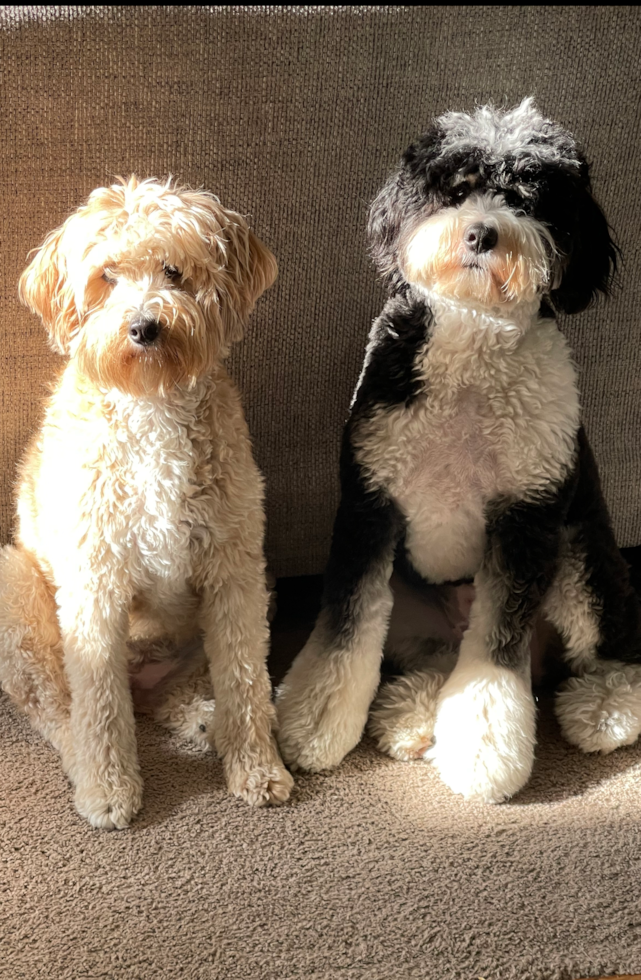
The difference between an F1 Mini Bernedoodle and an F1B Mini Bernedoodle usually comes down to predictability, coat traits, and how strongly the dog leans toward either the Bernese Mountain Dog side or the Poodle side genetically.
An F1 Mini Bernedoodle is a direct 50/50 cross between a Bernese Mountain Dog and a Miniature Poodle. An F1B Mini Bernedoodle is created by breeding an F1 Bernedoodle back to a Poodle, making the puppy genetically more Poodle-influenced.
This comparison causes a surprising amount of stress for buyers because people become very focused on choosing the “right” generation before fully understanding how daily life with these dogs actually feels.
The reality is that both generations can be wonderful companions. They simply create slightly different ownership experiences.
| Trait | F1 Mini Bernedoodle | F1B Mini Bernedoodle |
| Genetics | 50% Bernese Mountain Dog / 50% Miniature Poodle | Usually ~75% Poodle / 25% Bernese |
| Coat Predictability | Less predictable | More predictable |
| Shedding | Can vary significantly | Usually lower shedding |
| Coat Texture | Straight, wavy, or curly | Usually wavier or curlier |
| Grooming Needs | Moderate to high depending on coat | Higher due to denser curls |
| Allergy Friendliness | Variable | Usually better for allergy-sensitive homes |
| Appearance | Softer “balanced” doodle look | More Poodle-influenced visually |
| Personality | Balanced blend of both breeds | More Poodle-like mentally and behaviorally |
| Energy Level | Moderate to high | Slightly higher |
| Emotional Tendencies | Social, goofy, emotionally attached | Highly intelligent, alert, emotionally engaged |
One of the biggest differences owners notice involves coat consistency. F1 Mini Bernedoodles show much wider variation in shedding and appearance because first-generation genetics are less predictable. Some F1s develop low-shedding wavy coats. Others inherit straighter coats with noticeably more shedding.
F1Bs are usually chosen by people who want more consistency in coat type and lower shedding potential. Because they inherit stronger Poodle genetics, curlier coats and reduced shedding are more common. But that comes with increased grooming intensity too. Lower shedding usually means more coat maintenance, not less.
Temperament differences are more subtle but still noticeable. F1 Mini Bernedoodles feel like a very balanced blend between the Bernese Mountain Dog and Miniature Poodle. Many owners describe them as goofy, affectionate, warm, socially engaged, and slightly softer emotionally.
F1Bs sometimes feel more mentally intense or more Poodle-influenced behaviorally. They are extremely intelligent, alert, trainable, and emotionally responsive, but some owners feel that the stronger Poodle influence creates slightly higher mental energy or sensitivity compared to F1s.
That does not make one generation better than the other. It simply changes the personality feel in some dogs.
At What Age Do F1 Mini Bernedoodles Calm Down?
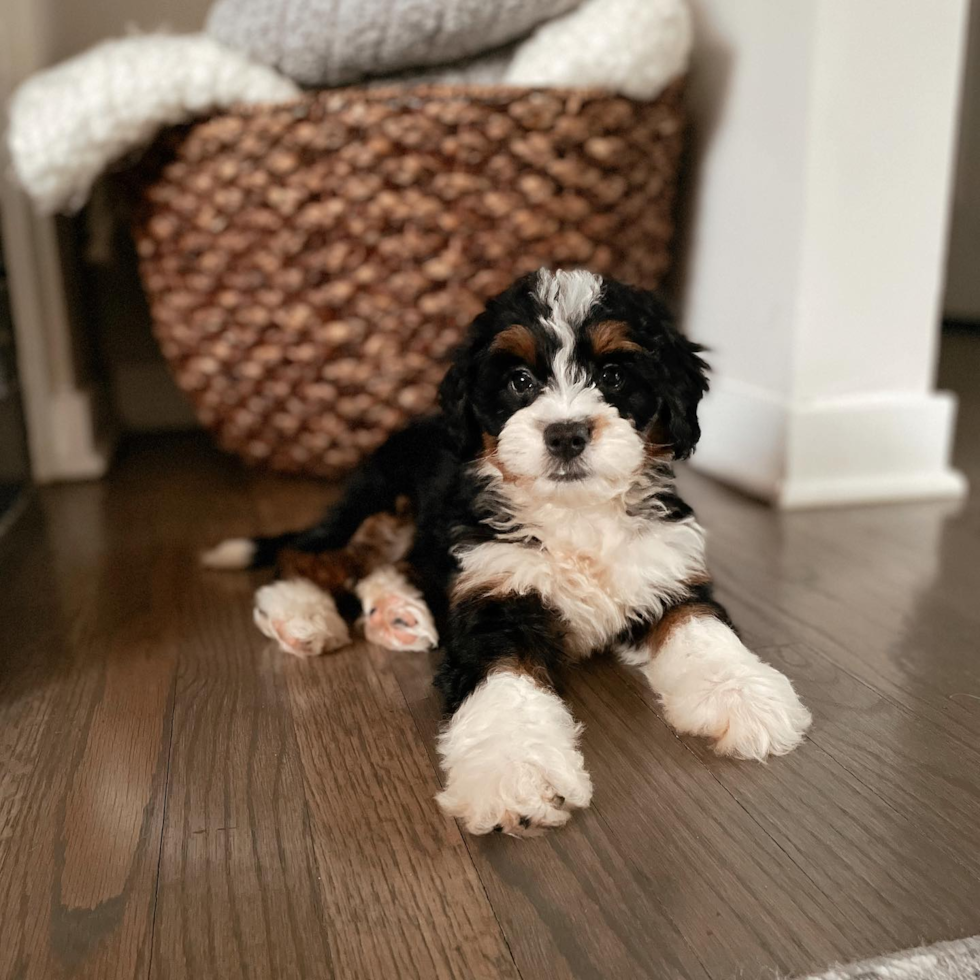
Most F1 Mini Bernedoodles begin settling noticeably between roughly 1.5 and 3 years old, although maturity rarely happens all at once. It usually develops gradually in layers. One day the dog suddenly recovers from excitement faster. A few months later the barking decreases. Then eventually you realize the chaotic adolescent that used to sprint through the house carrying stolen socks at full speed now settles quietly during normal daily life.
Adolescence is usually the hardest stage. F1 Mini Bernedoodles go through periods between 6 months and 2 years old where emotional impulses temporarily outrank logic almost entirely. Excitement spikes quickly. Focus disappears randomly. Barking increases. Settling is difficult. Impulse control weakens dramatically at times, even in dogs that already know basic training very well.
This phase can feel especially intense because F1 Mini Bernedoodles are emotionally engaged, socially attached, and mentally active dogs to begin with. Their nervous systems are highly responsive to the environment around them, which means adolescence sometimes feels less like “slightly more energetic behavior” and more like living with a furry tornado that suddenly reacts to absolutely everything.
Males may mature slightly slower in some cases, especially when it comes to impulse control and emotional steadiness. Many owners describe male F1 Mini Bernedoodles as goofy, socially intense, and puppy-like longer than females.
Is an F1 Mini Bernedoodle Right for You?
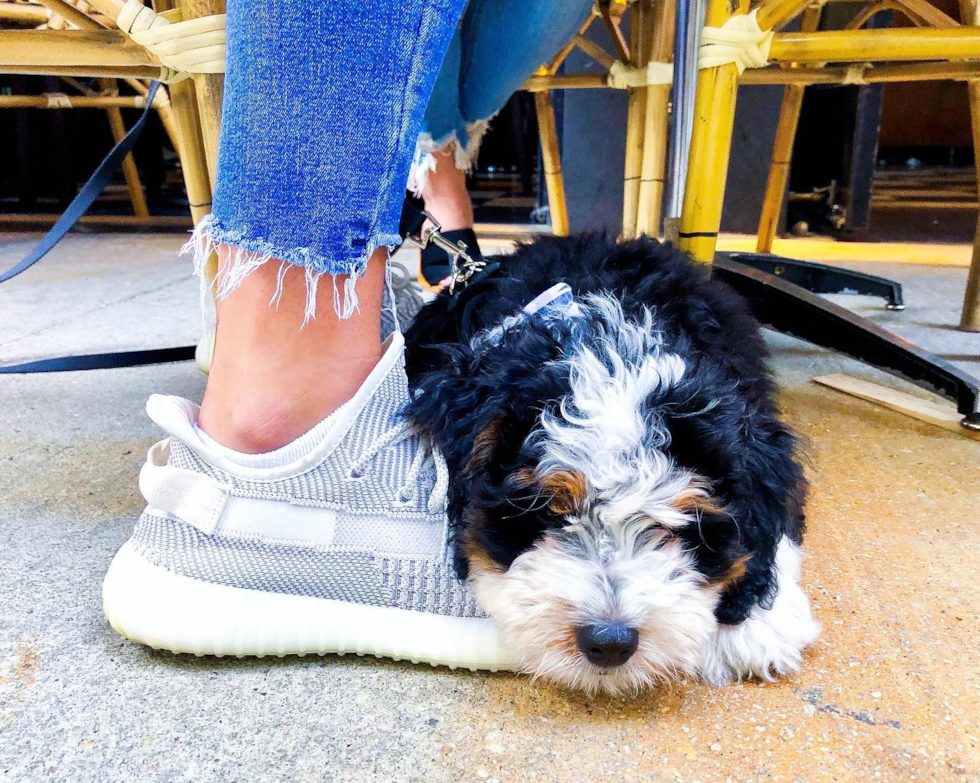
An F1 Mini Bernedoodle is usually a great fit for people who genuinely enjoy emotionally engaged dogs and want a companion that feels socially connected to everyday life rather than distant from it. These dogs thrive in homes where interaction, routine, affection, training, and engagement naturally become part of the daily rhythm instead of occasional activities squeezed in randomly.
A lot of owners fall deeply in love with the personality balance F1s bring. The goofy social energy. The emotional warmth. The playful intelligence. The way many seem to stay highly tuned into the people around them without losing that softer affectionate side that makes the breed feel so emotionally rewarding to live with.
But they are usually not the best fit for people who expect a perfectly predictable low-maintenance dog that naturally raises itself with minimal involvement.
F1 Mini Bernedoodles do best with owners who can provide structure, mental stimulation, emotional consistency, and enough engagement to keep intelligent sensitive dogs balanced long term. They want to participate in life closely, and many are happiest when they feel connected to the household rather than separate from it.
That engagement can feel incredibly rewarding for the right person. Especially for owners who work from home, active families who want a socially involved dog, or people who genuinely enjoy training, interaction, and companionship throughout the day.
At the same time, these dogs require more emotional and mental involvement than people initially expect from the cute teddy bear appearance alone. Understimulated F1 Mini Bernedoodles rarely stay quietly under-stimulated. Emotionally overwhelmed dogs usually find ways to express it too. Barking, attention-seeking, chaotic adolescence behavior, overstimulation, shadow-following, and difficulty settling appear when balance starts slipping.
Coat unpredictability matters here too. People who want guaranteed low shedding or highly specific appearance traits sometimes become frustrated with the natural variation that exists in F1s. Families comfortable with a little unpredictability appreciate the individuality that comes with first-generation dogs instead.
Grooming commitment deserves realistic consideration as well. Even lighter-shedding coats require regular brushing, professional grooming, and coat maintenance long term. The fluffy teddy bear look people love does not maintain itself naturally without consistent upkeep behind the scenes.
When the match lands right, living with an F1 Mini Bernedoodle feels less like simply owning a dog and more like sharing your house with a socially invested emotionally expressive little creature that somehow becomes involved in almost every part of life without anyone fully noticing when it happened.
Elena R.
About The Author
Elena is a leading expert in the field of dog behavior, care, and training, with over a decade of experience in writing about dogs. As a published writer and lifelong dog enthusiast, Elena currently shares her home with three beloved canine companions. She is dedicated to staying up to date on the latest advancements in dog care and training, ensuring that her articles provide readers with accurate and valuable insights. With her extensive knowledge and passion for all things canine, Elena's contributions to the Premier Pups community offer both expertise and authority on a wide range of dog-related topics.
What To Read Next
All Mini Bernedoodle Generations: F1, F1B, F2, Multigen & More
Mini Bernedoodle generations confuse almost everyone at first. One minute you’re researching adorable fluffy puppies, and the next you’re staring at terms like F1, F1B, F2, F1BB, multigen, and F3 trying to figure out whether you’re choosing a... Read More
Are Mini Bernedoodles Hypoallergenic? Shedding, Allergies & More
Mini Bernedoodles are described as hypoallergenic dogs, but the reality is a little more nuanced than that. While many Mini Bernedoodles inherit the low-shedding qualities of the Poodle, no dog is completely hypoallergenic. Some Mini Bernedoodles shed... Read More
Frequently Asked Questions
What does F1 mean in Mini Bernedoodle? F1 means first-generation cross. An F1 Mini Bernedoodle comes directly from a Bernese Mountain Dog and a Miniature Poodle, making the puppy roughly 50% Bernese and 50% Poodle genetically.
How big do F1 Mini Bernedoodles get? Most full-grown F1 Mini Bernedoodles weigh somewhere between 25 and 50 pounds and stand around 18 to 22 inches tall, although genetics influence size heavily.
Do F1 Mini Bernedoodles shed? Yes, some do. Shedding varies significantly in F1 Mini Bernedoodles because coat genetics are less predictable than later generations like F1Bs. Straighter coats usually shed more, while wavy and curly coats shed less.
Are F1 Mini Bernedoodles hypoallergenic? No dog is completely hypoallergenic, including F1 Mini Bernedoodles. Some may work reasonably well for mild allergy sufferers, especially dogs with curlier low-shedding coats, but allergy responses vary depending on coat type, dander, saliva, and individual sensitivity.
Are F1 Mini Bernedoodles calmer than F1B? Some owners feel F1 Mini Bernedoodles carry a slightly softer or more balanced emotional energy compared to F1Bs, which may inherit stronger Poodle influence mentally and behaviorally. But personality, routine, emotional regulation, and training shape calmness much more than generation alone.
Which is better, F1 or F1B Mini Bernedoodle? Neither generation is universally better. F1 Mini Bernedoodles feel like a balanced blend of Bernese and Poodle traits, while F1Bs usually offer more predictable low-shedding coats and stronger Poodle influence. The better fit depends on lifestyle, grooming expectations, allergy concerns, and personality preferences.
Are F1 Mini Bernedoodles good family dogs? Many are excellent family companions because they are affectionate, socially connected, playful, and emotionally engaged with the household around them. Training, socialization, supervision, and emotional balance still matter heavily, especially around young children.
Are F1 Mini Bernedoodles cuddly? A lot of them are extremely affectionate and physically attached to their families. Many develop velcro dog tendencies and genuinely enjoy staying close to their people throughout the day. Some are more independent than others, but emotional attachment is very common in the breed.
Do F1 Mini Bernedoodles bark a lot? Most are moderate barkers rather than excessively vocal dogs. Barking usually relates to alert behavior, emotional sensitivity, boredom, overstimulation, or attention-seeking patterns rather than nonstop random noise.
How often should an F1 Mini Bernedoodle be groomed? Most need brushing several times per week and professional grooming roughly every 6 to 10 weeks depending on coat type and coat length. Curlier coats usually require more intensive maintenance than looser wavy coats.
Are F1 Mini Bernedoodles easy to train? They are usually very intelligent and highly trainable, especially with positive reinforcement and consistent routines. But emotional sensitivity, adolescence, boredom, and overstimulation can create impulsive or stubborn behavior if structure falls behind.
Are F1 Mini Bernedoodles high maintenance? They can be moderately high maintenance because they need regular grooming, mental stimulation, training, engagement, and consistent routines to stay balanced. Lower shedding coats usually require even more grooming upkeep.
Do F1 Mini Bernedoodles have separation anxiety? Some can become very emotionally attached to their families and may struggle with isolation if independence skills are not developed gradually. Healthy routines, confidence-building, crate familiarity, and structured alone time usually help significantly.
How much exercise does an F1 Mini Bernedoodle need? Most need daily physical activity along with consistent mental stimulation. Walks, training sessions, enrichment games, sniff walks, and structured interaction usually matter just as much as exercise itself because these dogs are mentally active and emotionally engaged.
At what age do F1 Mini Bernedoodles calm down? Many begin settling noticeably between 1.5 and 3 years old. Adolescence can feel intense, especially during the first two years, but emotional regulation, impulse control, and calmness usually improve gradually with maturity, structure, and training.
Are F1 Mini Bernedoodles good for first-time owners? They can be wonderful for first-time owners who are prepared for an intelligent emotionally engaged dog that needs structure, grooming, training, and regular interaction. Many adapt beautifully when expectations are realistic and routines are consistent.
What coat type do F1 Mini Bernedoodles usually have? Wavy fleece coats are probably the most common, but F1 Mini Bernedoodles can also develop straight or curly coats depending on genetics. Coat variation is much wider in F1s compared to later generations bred for more consistency.
Do F1 Mini Bernedoodles stay small? Not always. Even though they are considered “mini,” adult size still varies significantly depending on genetics and parent size. Some stay compact around 25 pounds, while others mature closer to 45 or 50 pounds with a larger frame.