





Published Friday, September 25, 2026 by Elena R. in Popular Dogs, New Puppy, Dog Grooming
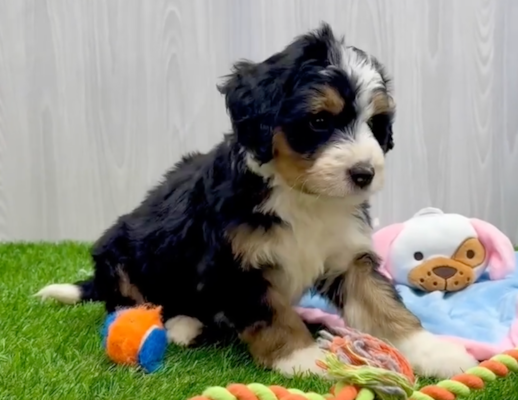
A Tricolor Mini Bernedoodle carries one of the most recognizable looks associated with the breed. Black usually covers most of the coat, white brightens the chest, face, and paws, and warm tan or rust markings sit above the eyes, along the cheeks, and around the legs. Put those three colors together on a fluffy Mini Bernedoodle and the connection to the Bernese Mountain Dog is pretty hard to miss.
The pattern can look beautifully precise on some dogs and much more relaxed on others. One puppy may have neat copper eyebrows, a narrow white blaze, and four white feet. Another may have a broad white chest, uneven facial markings, and tan that spreads farther through the legs and cheeks. Both can still be tricolor.
There is another layer to the story once the puppy begins growing. Mini Bernedoodles can inherit coat-color traits from both sides of their ancestry, and the Poodle side adds more variation. Deep black may soften toward charcoal or gray in some dogs. Rich rust can become lighter tan. Longer curls can blur markings that looked incredibly sharp at eight weeks old. So while “tricolor” sounds simple enough, there is quite a bit happening inside those three colors.
Table of Contents
- What Is a Tricolor Mini Bernedoodle?
- Why Tricolor Mini Bernedoodles Look So Much Like Bernese Mountain Dogs
- Where Are the Tan Markings on a Tricolor Mini Bernedoodle?
- Are the Brown Markings on a Tricolor Mini Bernedoodle Actually Brown?
- Black Tricolor Mini Bernedoodles
- Chocolate Tricolor Mini Bernedoodles
- Is a Black and Brown Mini Bernedoodle Tricolor?
- Where Does the Tricolor Pattern Come From?
- Do Tricolor Mini Bernedoodles Change Color?
- Are Tricolor Mini Bernedoodles Rare?
- Does Tricolor Coloring Affect Temperament or Coat Type?
- What to Look for When Choosing a Tricolor Mini Bernedoodle
- Final Thoughts on Tricolor Mini Bernedoodles
What Is a Tricolor Mini Bernedoodle?
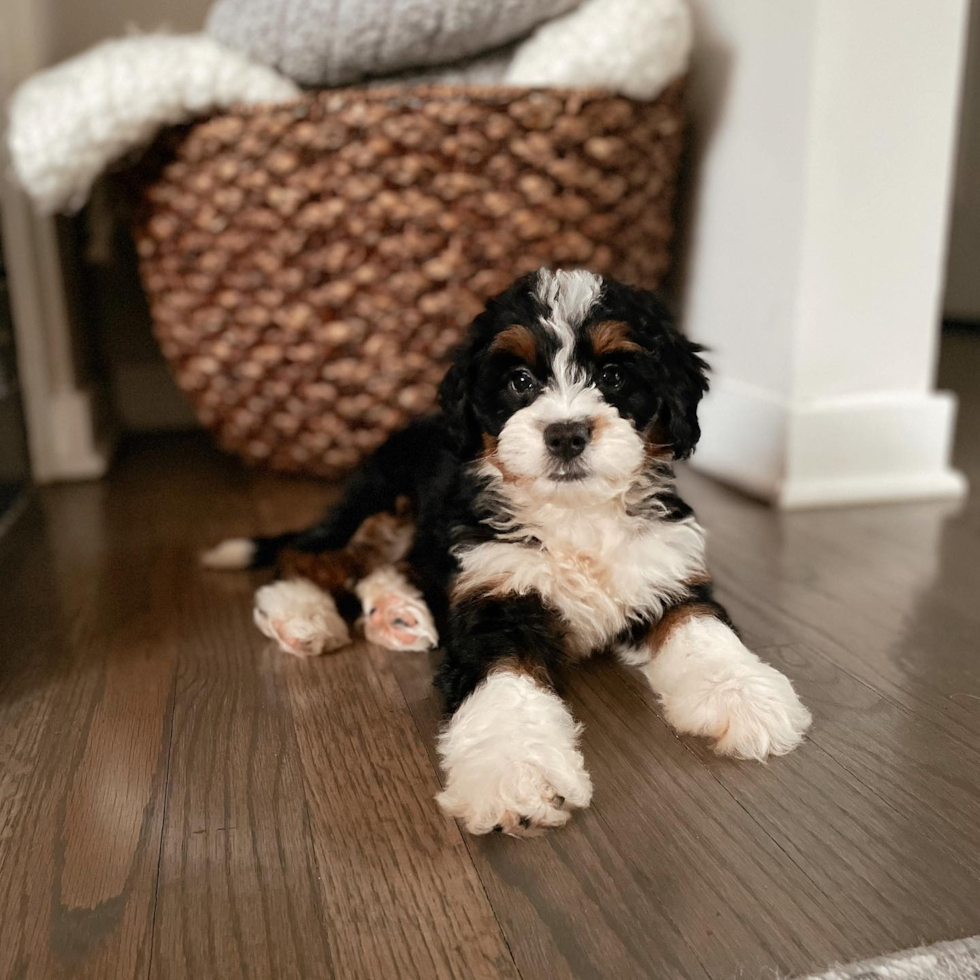
A Tricolor Mini Bernedoodle has three visible coat colors. In the classic Bernese-inspired version, those colors are black, white, and rust or tan.
The pattern comes largely from the Bernese Mountain Dog side of the mix. Purebred Bernese Mountain Dogs are famously tricolored, with a jet-black ground color, rich rust markings, and clearly defined white areas. According to the AKC breed standard, rust typically appears above the eyes, on the cheeks, on each side of the chest, on all four legs, and beneath the tail. White usually appears as a facial blaze and muzzle band, on the chest, at the feet, and at the tip of the tail.
A Mini Bernedoodle can inherit a very similar arrangement without copying it perfectly. Mixed breeds have more room for variation, and the Poodle ancestry introduces additional colors, modifiers, coat textures, and patterns.
Some tricolor Mini Bernedoodles therefore look remarkably Bernese-like. Others have the same three-color idea but with a wider blaze, more white through the body, softer tan points, or less symmetrical markings.
RELATED: Learn About Mini Bernedoodles
Why Tricolor Mini Bernedoodles Look So Much Like Bernese Mountain Dogs
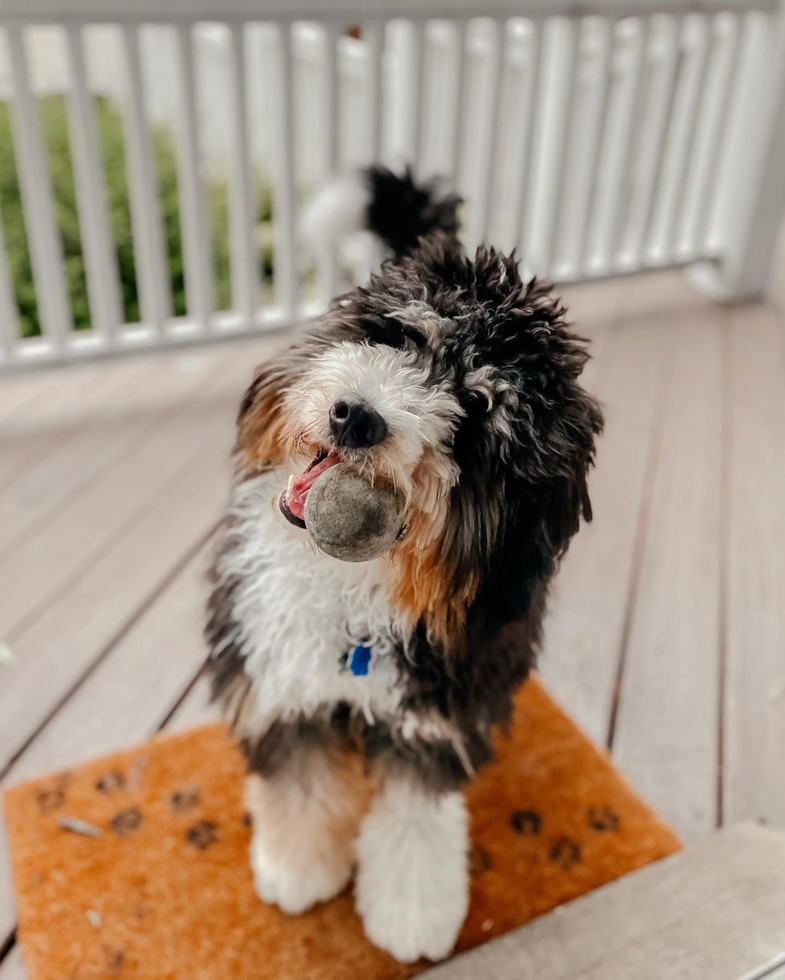
Among all Mini Bernedoodle colors, tricolor is probably the one that shows the Bernese influence most clearly.
The traditional Bernese Mountain Dog has a black body framed by rich rust and bright white. Those rust markings are especially recognizable around the face. Small spots over the eyes create the expressive “eyebrow” look, while color on the cheeks, muzzle, chest, and legs gives the face and body more definition.
Mini Bernedoodles that inherit similar markings can look like smaller, curlier versions of that classic pattern. Coat texture changes the effect quite a bit, though. Bernese Mountain Dogs have a thick coat that is straight or slightly wavy. Mini Bernedoodles may inherit loose waves, soft curls, or a much curlier Poodle-style coat.
On a wavy Mini Bernedoodle, the black, white, and tan sections are easy to distinguish from a distance. Dense curls break those same markings into smaller visual pieces, especially once the coat grows long.
A face that looked neatly divided into black, white, and copper at ten weeks can become considerably fluffier six months later. The colors are still there. They are simply hiding beneath several inches of enthusiastic doodle hair.
RELATED: All Mini Bernedoodle Generations: F1, F1B, F2, Multigen & More
Where Are the Tan Markings on a Tricolor Mini Bernedoodle?
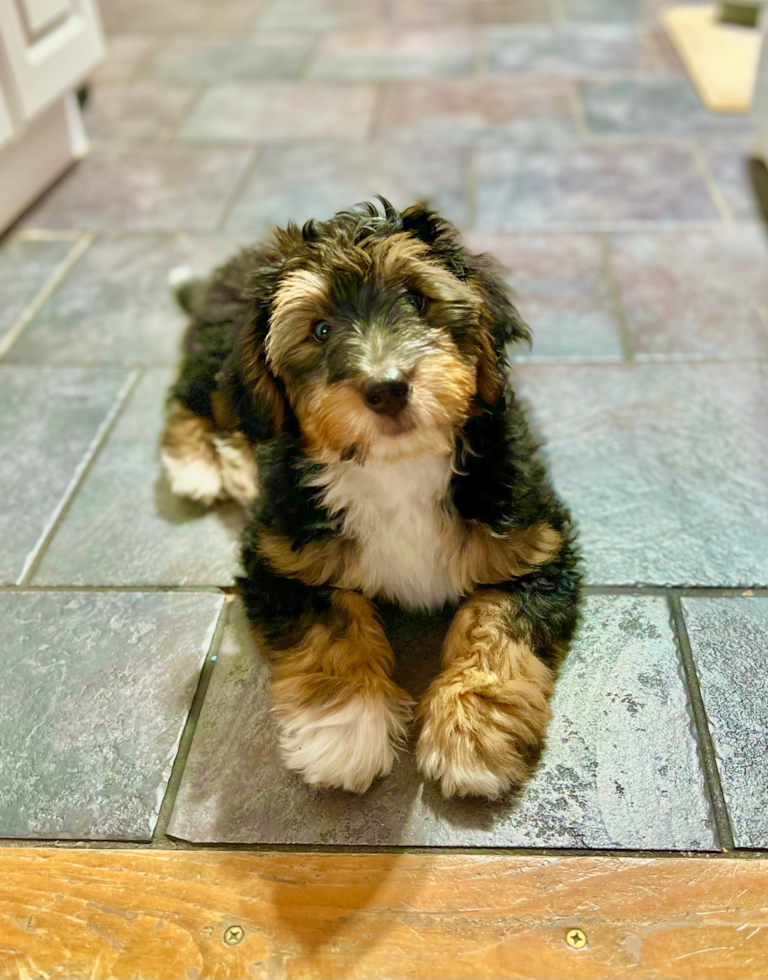
The tan markings are one of the details that separate a classic tricolor from a simple black-and-white Mini Bernedoodle.
Tan appears in predictable areas because the distribution of black and red/yellow pigment in dogs is genetically controlled. In tan-pointed patterns, warmer pigment commonly appears above the eyes, on the cheeks and muzzle, across portions of the chest, on the legs, and beneath the tail. Veterinary genetics research describes these patterns as the result of genes controlling where darker eumelanin and warmer phaeomelanin are expressed in the coat.
On a Tricolor Mini Bernedoodle, the most noticeable tan markings are usually the eyebrows. Those two little spots can have an impressive effect on the dog's expression. A puppy can look curious, worried, deeply suspicious of your dinner, or mildly offended by bath time depending on what those eyebrows appear to be doing.
Tan may also appear along the sides of the muzzle and cheeks, inside or around the legs, and where black coat transitions into white on the chest.
The exact shade varies too. Some Mini Bernedoodles have deep rust or copper points similar to a Bernese Mountain Dog. Others have lighter caramel, golden tan, beige, or cream-toned markings.
RELATED: F2 Mini Bernedoodle Guide: Coat Types, Shedding, Grooming & More
Are the Brown Markings on a Tricolor Mini Bernedoodle Actually Brown?

People search for black and brown Mini Bernedoodles quite often, and visually the description makes perfect sense. A dog has black fur, warm brown-looking eyebrows and legs, maybe some white, so “black and brown” feels like the obvious name. But dog-color terminology makes things slightly more complicated.
The warm markings on a classic black tricolor are usually better described as tan, rust, or copper rather than genetically brown. Black and true chocolate-brown pigment belong to one pigment family, while tan, red, yellow, cream, and rust belong to another.
Black and brown are forms of eumelanin, while red and yellow shades come from phaeomelanin. The brown gene specifically changes black pigment into brown without changing the red or yellow portions of the coat. Nobody needs to perform a pigment analysis every time they compliment a puppy, of course.
Calling rust markings “brown” in everyday conversation is perfectly understandable. The distinction is useful when comparing a black tricolor Mini Bernedoodle with a chocolate tricolor Mini Bernedoodle, because those dogs actually have different underlying dark pigment.
RELATED: Mini Bernedoodle Multigen Generations: F1BB, F2B & F3 & more
Black Tricolor Mini Bernedoodles
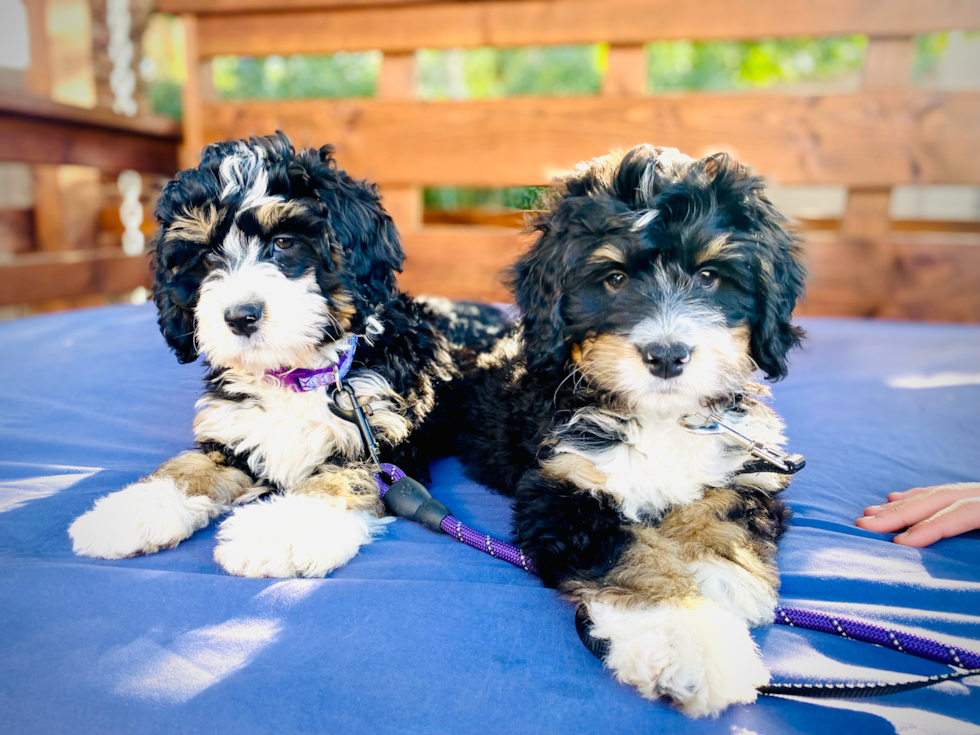
The black tricolor Mini Bernedoodle is the classic version of the pattern and the closest visual match to the Bernese Mountain Dog.
Black forms the main coat color. White usually appears on some combination of the face, muzzle, chest, paws, and tail, while tan or rust points add warmer color above the eyes, along the cheeks, chest, and legs.
The balance among those colors can vary considerably. Some puppies are predominantly black with relatively small white markings. Others have broad white chests and facial blazes that make the entire coat look brighter. Tan may be rich and obvious or limited to smaller patches around the eyebrows and legs.
Symmetry varies as well. Bernese Mountain Dog breed standards favor carefully placed, symmetrical markings, but Mini Bernedoodles are a crossbreed and do not have an official AKC color standard dictating where every patch should sit.
One eyebrow can be larger than the other. A white blaze may lean slightly to one side. One front leg may have considerably more white. These little imperfections are exactly what make an individual puppy recognizable.
RELATED: Merle Mini Bernedoodle: Blue Merle, Chocolate Merle & Blue Eyes
Chocolate Tricolor Mini Bernedoodles
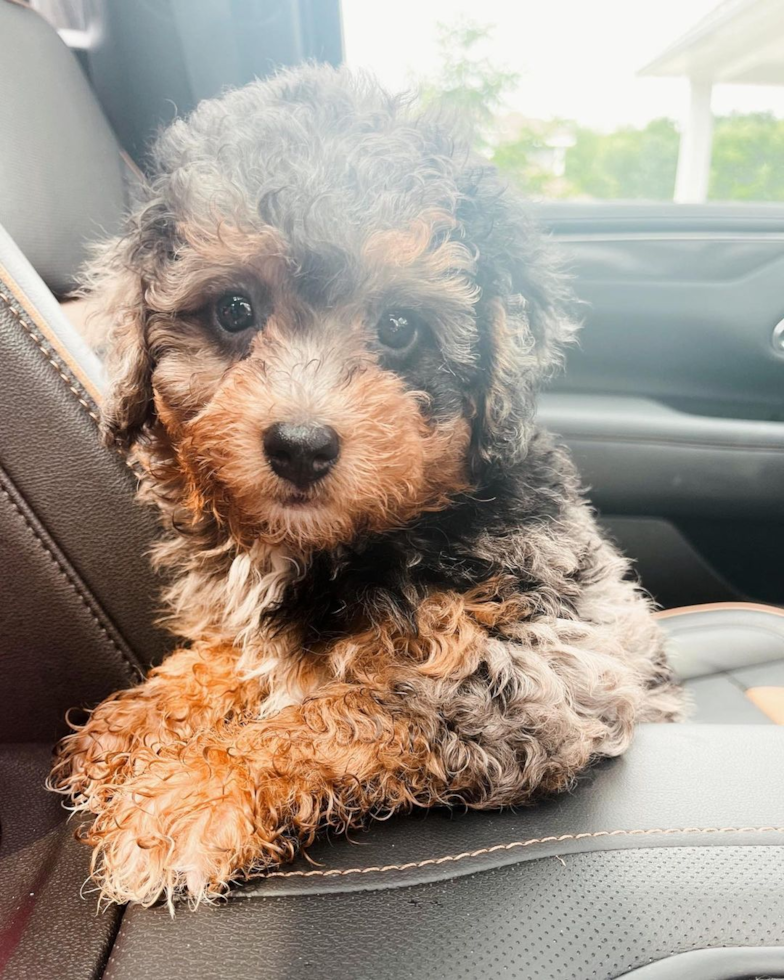
Tricolor does not always have to mean black, tan, and white. A chocolate tricolor Mini Bernedoodle has brown or chocolate as the darker base pigment instead of black. White and tan or copper markings can then appear alongside it, creating three visible colors in a warmer palette.
True chocolate affects more than the hair. Brown-based dogs commonly have brown or liver-colored pigmentation on the nose, lips, and eye rims rather than the black pigment seen on a black tricolor. Tthe same genetic change responsible for brown coat pigment also changes black pigment in areas such as the nose and paw pads to brown.
Chocolate tricolors can range from deep espresso brown to softer cocoa shades. Tan points may blend more subtly into the surrounding brown than they do against a jet-black coat, especially when the two colors are close in intensity. And white usually provides the strongest contrast.
The finished effect can look quite different from the classic Bernese-inspired tricolor even though the basic pattern follows the same three-color idea.
RELATED: Do Mini Bernedoodles Shed? Coat Types and Allergies Explained
Is a Black and Brown Mini Bernedoodle Tricolor?
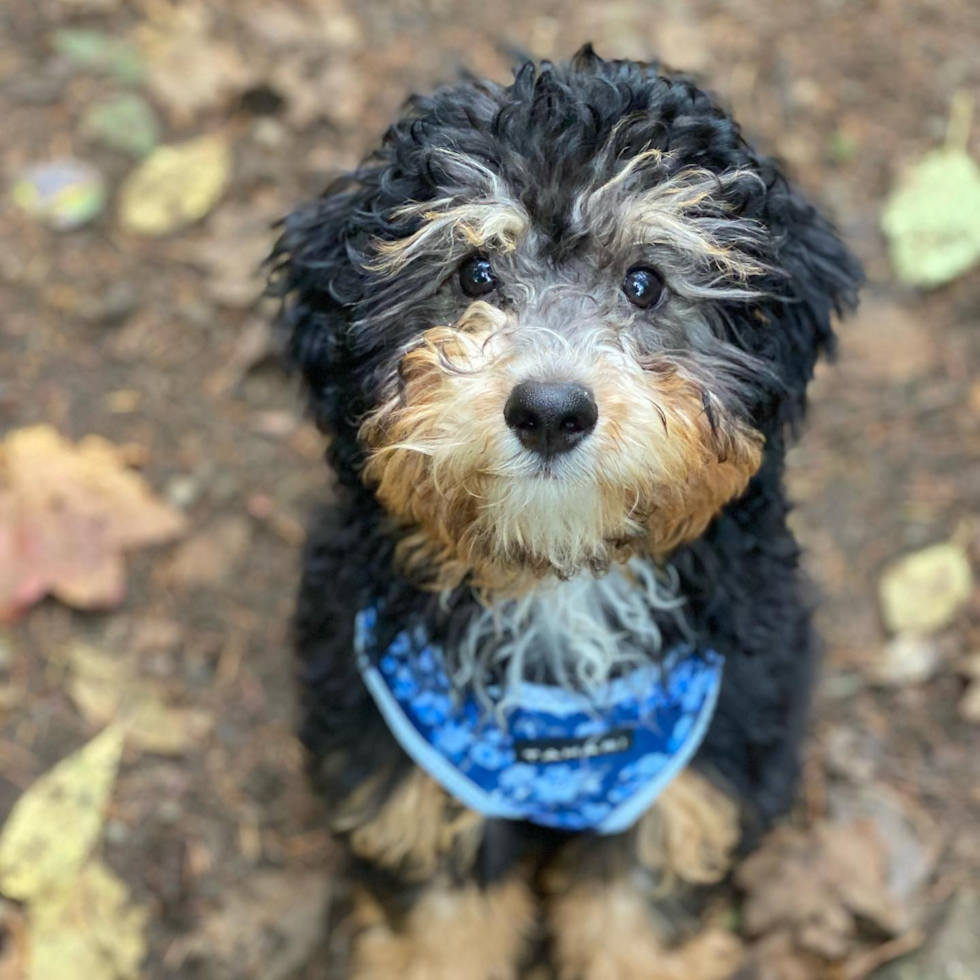
Sometimes, but not automatically. A dog needs three visible colors to be described accurately as tricolor. A Mini Bernedoodle with black, tan or brown markings, and noticeable white fits the tricolor description.
A dog with only black and tan markings has two visible colors. Depending on the exact pattern, that dog may fall into a different color category such as phantom. The confusion usually happens because people mentally group white markings into the dog's overall appearance without naming them.
Someone searching for a “black and brown Mini Bernedoodle” may actually be picturing the classic black, rust, and white tricolor. Search language and genetics do not always speak the same dialect. For practical purposes, count the visible colors. Black plus tan is two. Black plus tan plus white is three.
Where Does the Tricolor Pattern Come From?
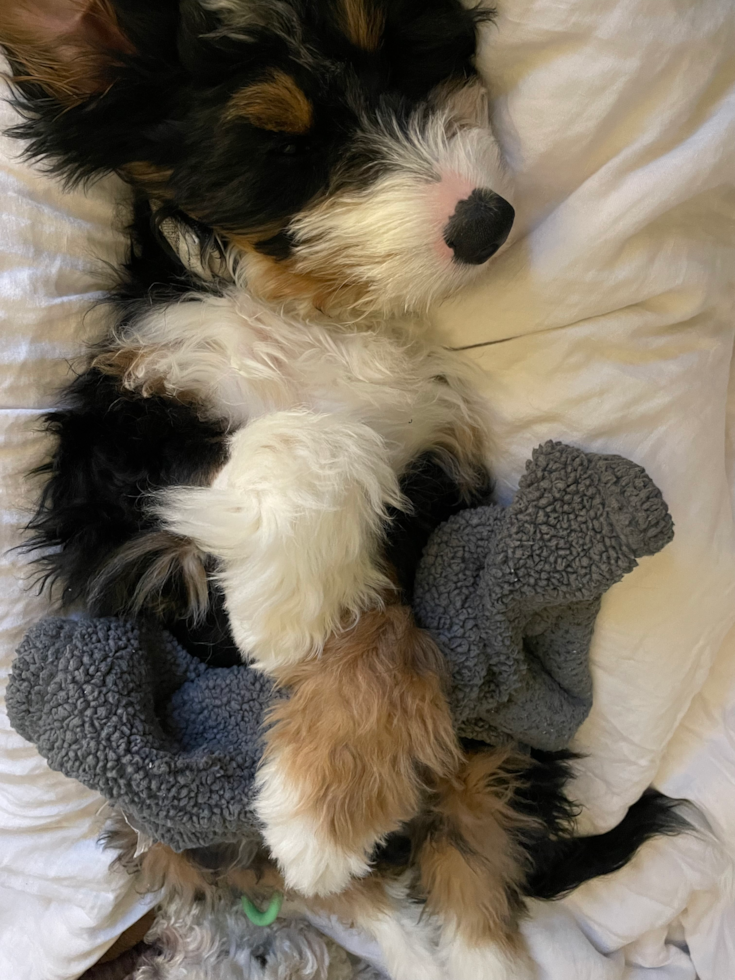
The strongest foundation for the classic tricolor pattern comes from the Bernese Mountain Dog, where black, rust, and white are fundamental breed characteristics.
The Poodle brings a much wider color palette into the Mini Bernedoodle mix. Recognized Poodle colors include black, brown, blue, gray, silver, cream, apricot, red, white, café au lait, and silver beige.
Combining those two genetic backgrounds is one reason Mini Bernedoodle colors can vary so much more than the traditional Bernese coat.
A first-generation Mini Bernedoodle may inherit strong Bernese-style markings, while later generations can produce a broader range depending on the colors and patterns carried by the Bernedoodle and Poodle parents involved.
Breeders can make informed predictions based on parental colors, markings, pedigrees, and genetic information, but a mixed-breed litter still has room for surprises. Puppies from the same litter may receive different combinations of color traits and end up looking remarkably different. One may inherit a textbook-looking tricolor coat. Another may have far less white. A third can carry colors that lean much more strongly toward the Poodle side. The family resemblance is there, but genetics does not photocopy puppies.
RELATED: What Is an F1B Mini Bernedoodle? Size, Coat Type & More
Do Tricolor Mini Bernedoodles Change Color?

Yes, some do. Probably the most important expectation to set with any Tricolor Mini Bernedoodle is that the puppy coat may not stay exactly the same shade throughout adulthood.
The overall pattern stays recognizable. A dog that has white on the chest and tan eyebrows does not normally wake up one morning with those markings rearranged across its back. The intensity of the colors, however, can change.
Poodle ancestry is especially relevant here. Progressive greying is documented in Poodles and several other breeds, and it can gradually lighten dark pigment over time. Research describes the process as black pigment becoming progressively gray over a period of months, although onset and degree vary among dogs and the full genetic mechanism is more complicated than the popular phrase “Poodle fading gene” suggests.
A black tricolor Mini Bernedoodle may therefore stay deep black throughout life, or portions of the dark coat may soften toward charcoal, smoky gray, or silver as the dog matures. Predicting exactly which puppy will fade and how far is not always possible from appearance alone.
Can the Black on a Tricolor Mini Bernedoodle Turn Gray?
It can. Some Mini Bernedoodles inherit a tendency for dark pigment to progressively lighten through their Poodle ancestry. Black may gradually become charcoal, blue-gray, or silver-toned rather than staying the deep black seen in puppyhood.
The change is usually gradual. Owners might first notice lighter hair around the muzzle, face, or roots. As more adult coat grows, the difference becomes increasingly obvious. A dog photographed at three months may therefore look considerably darker than the same dog at two years old.
Not every black tricolor fades. Some stay richly black well into adulthood, aside from ordinary age-related graying much later in life. Others change enough that old puppy photos almost look as though they belong to a darker-colored sibling.
Poodle breed literature also recognizes color clearing in several established Poodle colors. Blue Poodles, for example, can begin life much darker and lighten as they mature.
The safest expectation is flexibility. A tricolor puppy gives you a good view of the pattern, but not always the final intensity of every shade.
Do the Tan Markings Change Color?
Tan points can change too, although the effect varies considerably. A puppy with deep copper eyebrows may develop lighter caramel or golden-tan markings with age. Other dogs retain rich rust coloring into adulthood.
Red and yellow pigment exists on a wide spectrum in dogs, from deep red through tan and cream, and multiple genetic factors influence its intensity. The shade of red/yellow pigment is affected by several genes rather than one simple switch.
Sun exposure, coat growth, grooming, and the transition from puppy coat to adult coat can also change how those markings look to the eye. Long curls may dilute the visual impact of a small tan eyebrow simply by surrounding it with more black hair. A short groom can make the exact same marking look much stronger again.
Do the White Markings Change as a Tricolor Mini Bernedoodle Grows?
White tends to be more visually stable than the pigmented areas, although its proportions can appear different as the puppy grows.
A broad white blaze on a tiny puppy's forehead may look narrower once the skull and muzzle mature. A chest patch that seems to cover half of a young puppy can appear more modest on a full-grown adult.
Hair length can make white areas look larger too, especially on the chest and legs where fluffy coat spreads outward. The actual white pattern generally does not migrate around the body. Growth simply changes the canvas underneath it.
Small changes can also become visible after grooming. Trimming several inches of curly coat may expose where the pigmented hair actually begins and ends, making white markings look sharper than they did before the haircut.
Anyone who has ever picked up a freshly groomed doodle and briefly wondered whether the groomer returned the correct dog will understand how dramatic coat length can be.
RELATED: Everything You Need to Know About Puppy Color Changes
Are Tricolor Mini Bernedoodles Rare?
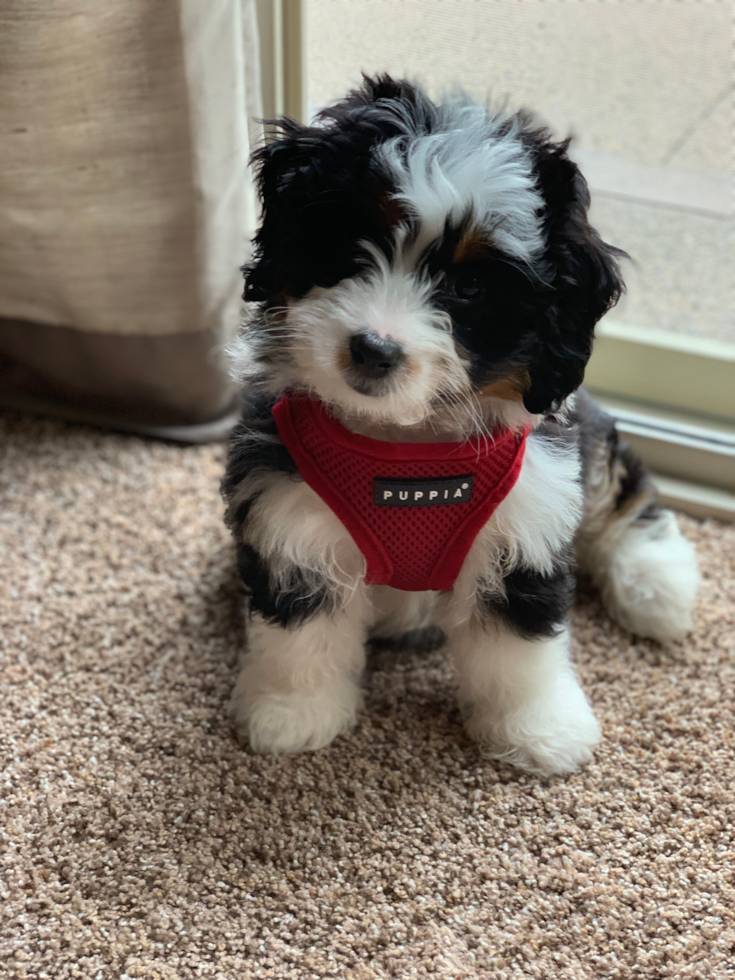
Tricolor is strongly associated with Bernedoodles because of the Bernese Mountain Dog ancestry, but there is no reliable population-wide data showing exactly how common or rare a tricolor Mini Bernedoodle is.
Different breeding programs produce different percentages depending on the dogs in their lines.
Some pairings can produce tricolor puppies more consistently. Others may produce solid colors, bicolors, phantom patterns, merles, or several combinations within the same litter.
A very specific tricolor appearance can be harder to produce than the general pattern. For example, someone looking for a puppy with a deep black coat, bright copper points, a perfectly centered white blaze, four white feet, and minimal fading potential is asking for several characteristics to line up at once.
Does Tricolor Coloring Affect Temperament or Coat Type?
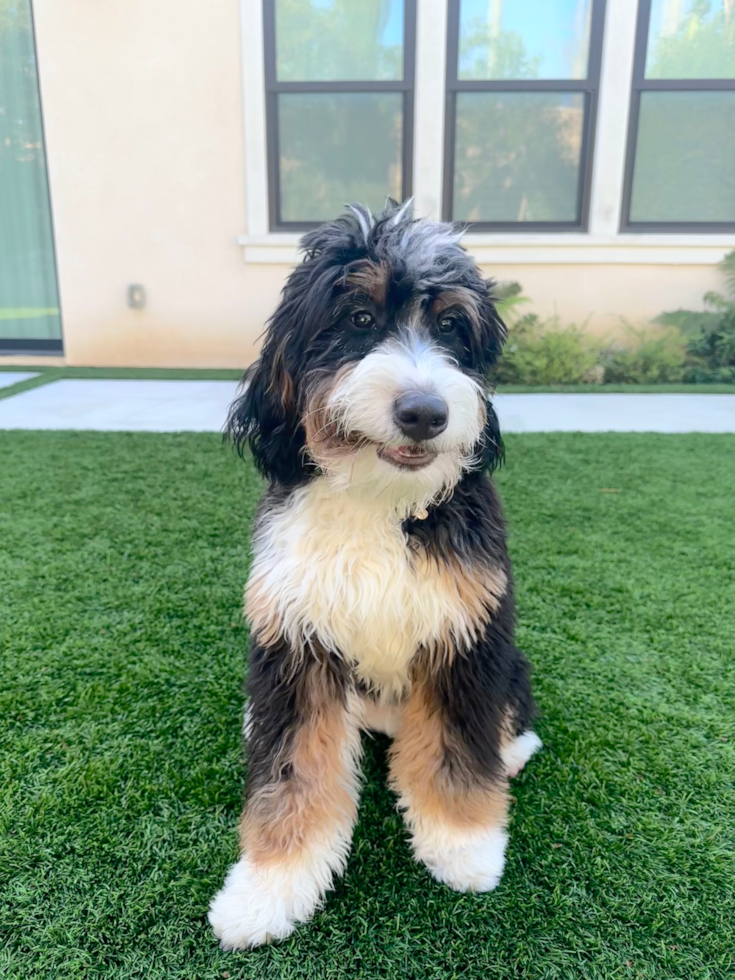
Tricolor describes pigmentation and markings, not personality. A tricolor Mini Bernedoodle is not more affectionate, calmer, smarter, or more Bernese-like simply because the coat resembles a Bernese Mountain Dog.
Temperament is shaped by a much broader combination of genetics, parental temperament, early development, socialization, training, and individual personality.
Coat texture is separate as well. A tricolor Mini Bernedoodle can be curly, wavy, or relatively straight. The dog may inherit stronger Poodle-style furnishings and curls while still displaying very traditional Bernese-inspired colors.
Shedding cannot be predicted from tricolor coloring either. Color tells you what the coat looks like. It does not tell you how much of that coat will eventually end up on your black pants.
RELATED: Are Mini Bernedoodles Good Family Dogs? What Life Really Looks Like
What to Look for When Choosing a Tricolor Mini Bernedoodle
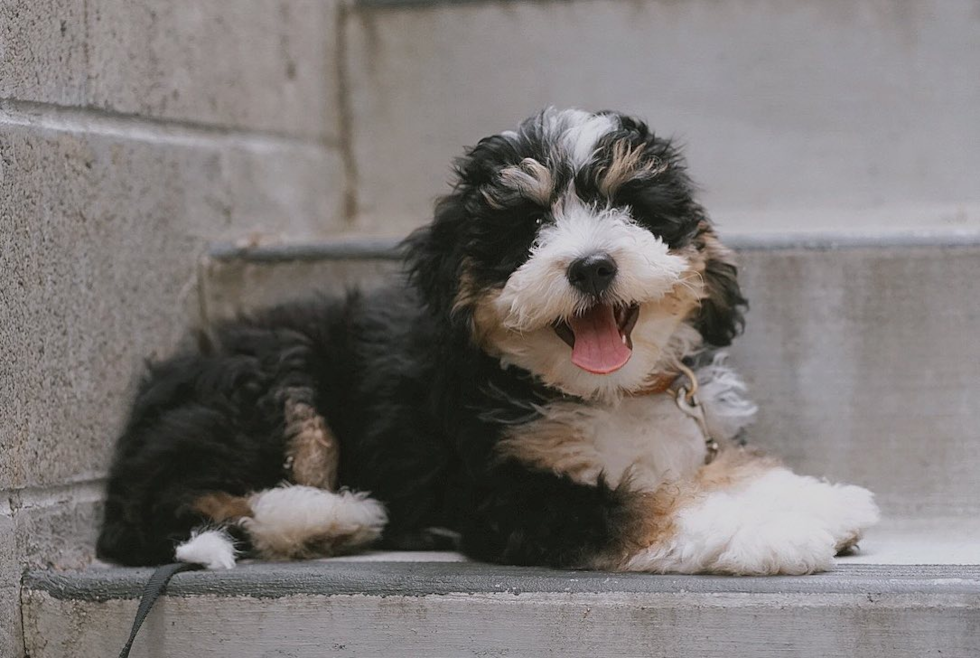
Color can absolutely be part of choosing a puppy. Tricolor is beautiful, distinctive, and closely connected with the appearance people imagine when they first hear the word Bernedoodle. Realistic expectations make the process much easier.
Look at the puppy's current pattern but pay attention to coat texture as well as color. A curly tricolor and a loose-wavy tricolor can look surprisingly different as adults even when their markings are similar as puppies.
Then give the rest of the dog the weight it deserves. Temperament, health, early care, socialization, expected adult size, and compatibility with your household will affect everyday life far more than whether one white sock reaches slightly higher than the other.
The tricolor pattern may be what catches your eye first, and there is nothing wrong with that. Eventually, though, those perfectly placed copper eyebrows are mostly going to be used to stare at you while you eat something your mini bernedoodle is convinced should be shared.
RELATED: Mini Bernedoodle Pros and Cons
Final Thoughts on Tricolor Mini Bernedoodles
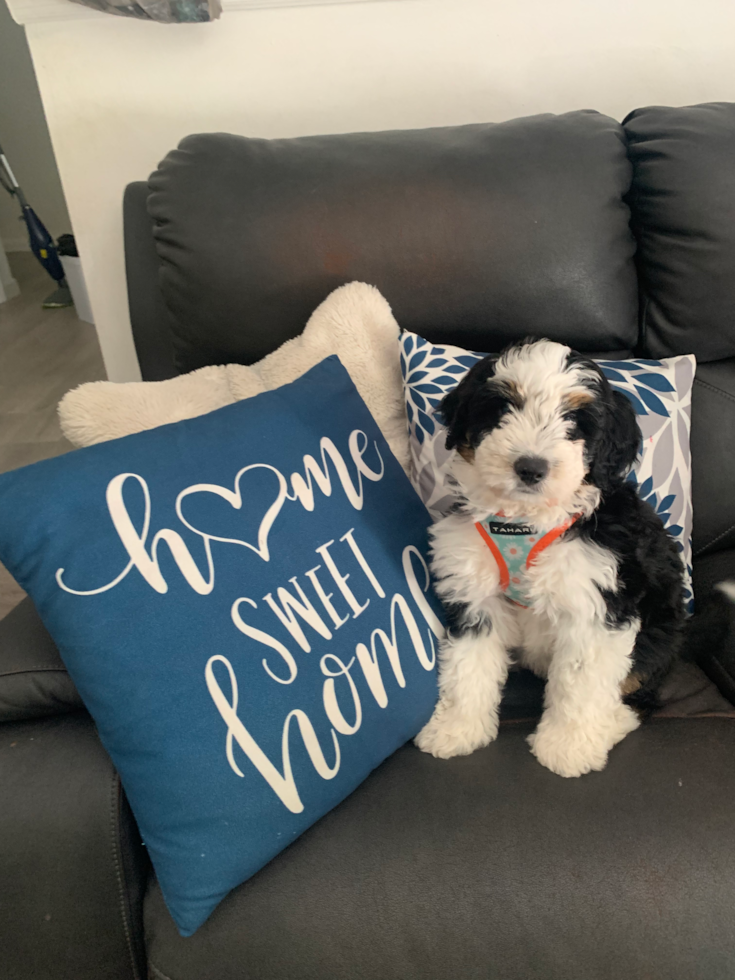
The Tricolor Mini Bernedoodle carries a little visual history in its coat. Black, rust, and white trace strongly back to the Bernese Mountain Dog, where those colors and their familiar placement have defined the breed for generations. The Poodle side adds another layer of variation, from coat texture to the possibility of colors softening as the dog matures.
The classic version has a predominantly black coat, white through areas such as the face, chest, and feet, and warm tan or rust points above the eyes and along the cheeks and legs. Chocolate tricolors follow a similar pattern with brown replacing the black base, while individual puppies can vary considerably in how much of each color they inherit.
Knowing the difference between brown and tan also makes the terminology clearer. A “black and brown Mini Bernedoodle” may actually have black with rust-colored points, and once white joins the picture, the dog fits comfortably within the tricolor family.
Color changes deserve realistic expectations too. Some tricolors stay wonderfully dark. Others inherit progressive greying from their Poodle ancestry and soften toward charcoal or gray. Copper points may lighten to tan, while the growth of the adult coat can make familiar markings look more blended than they did on a young puppy.
None of those changes makes the adult coat better or worse. They are simply part of the genetic variety that comes with combining two very different breeds.
A perfectly marked tricolor puppy is undeniably beautiful. A slightly crooked blaze, one oversized eyebrow, or a white sock that climbs higher than the others can be just as memorable.
In the end, tricolor gives you the palette. The individual Mini Bernedoodle decides what to do with it.
Elena R.
About The Author
Elena is a leading expert in the field of dog behavior, care, and training, with over a decade of experience in writing about dogs. As a published writer and lifelong dog enthusiast, Elena currently shares her home with three beloved canine companions. She is dedicated to staying up to date on the latest advancements in dog care and training, ensuring that her articles provide readers with accurate and valuable insights. With her extensive knowledge and passion for all things canine, Elena's contributions to the Premier Pups community offer both expertise and authority on a wide range of dog-related topics.
What To Read Next

Parti Mini Bernedoodles: Black & White, Brown & White, +More
A Parti Mini Bernedoodle stands out for a very different reason than a classic tricolor. Instead of black, rust, and white arranged in the familiar Bernese pattern, a parti coat uses white as a major part of the design. Large patches of black, brown, red, apricot,... Read More
Are Mini Bernedoodles Aggressive? What Owners and Experts Say
Mini Bernedoodles have a reputation that precedes them. Fluffy, affectionate, deeply people-oriented — the kind of dog that greets every visitor like a long-lost friend and considers your lap a permanent reservation.
Mini bernedoodles are not an aggressive... Read More
Frequently Asked Questions
What colors are in a Tricolor Mini Bernedoodle? The classic Tricolor Mini Bernedoodle has black, white, and tan or rust coloring. Black usually forms the main coat, white commonly appears on the face, chest, and feet, and tan or rust markings often appear above the eyes, along the cheeks, chest, and legs.
Is tan the same as brown on a Mini Bernedoodle? Not technically. People call tan or rust markings brown because that is how they look visually. In canine color genetics, however, true brown or chocolate pigment is different from the red/yellow pigment responsible for tan and rust shades. The distinction matters most when comparing a black tricolor with a chocolate tricolor.
What is a black and brown Mini Bernedoodle? The phrase can describe several appearances. A black Mini Bernedoodle with tan or rust points may be casually called black and brown. If noticeable white is present too, the dog may be tricolor. A dog with black and tan but no significant white is a two-color pattern rather than tricolor.
Why do Tricolor Mini Bernedoodles have brown eyebrows? The “brown eyebrows” are usually tan or rust points inherited as part of the dog's pigment pattern. Similar markings occur in Bernese Mountain Dogs, where rich rust is expected above each eye, on the cheeks, chest, legs, and beneath the tail.
Do Tricolor Mini Bernedoodles stay black? Some do, while others lighten. Progressive greying is found in Poodles and can be inherited by Poodle mixes. A black tricolor Mini Bernedoodle may therefore remain deep black or gradually become charcoal, gray, or more silver-toned. The amount of change varies from dog to dog.
Do Tricolor Mini Bernedoodles lose their tan? Tan markings can become lighter or less visually obvious as the coat matures, but they do not necessarily disappear. Coat texture, grooming length, pigment intensity, and inherited color traits all influence how noticeable the tan areas remain in adulthood.
Can a Tricolor Mini Bernedoodle turn gray? Yes, some can. Dark pigment may progressively lighten through traits inherited from Poodle ancestry. A puppy that begins with a jet-black coat can develop charcoal, gray, or silver tones as the adult coat matures. Not every tricolor Mini Bernedoodle experiences significant fading.
Can a Tricolor Mini Bernedoodle be brown instead of black? Yes. Chocolate tricolor Mini Bernedoodles have brown or chocolate as the darker base pigment, combined with lighter tan or copper points and white markings. They often have brown or liver-colored noses rather than black ones.
Are Tricolor Mini Bernedoodles always symmetrical? No. Some have wonderfully balanced markings, while others have uneven blazes, different-sized tan eyebrows, mismatched white feet, or more color on one side of the face. Symmetry affects appearance, not whether the dog is genuinely tricolor.
Are Tricolor Mini Bernedoodles more expensive? Pricing varies considerably among breeders and depends on far more than color. High demand for traditional Bernese-style tricolor markings can influence pricing in some programs, but a particular coat pattern does not make one puppy healthier or better tempered than another.
Is tricolor inherited from the Bernese Mountain Dog? The classic black, rust, and white appearance is strongly inherited from the Bernese Mountain Dog side. Poodle ancestry adds more color possibilities and can influence how shades mature or lighten, which is why Mini Bernedoodle tricolors can show more variation than purebred Bernese Mountain Dogs.
Does a Tricolor Mini Bernedoodle's coat change after grooming? Grooming does not change the dog's underlying color genetics, but it can change how the pattern looks. Long curls blend neighboring colors and can hide smaller markings. A shorter haircut makes the boundaries between black, white, and tan appear much sharper.